Vent-Free Gas Heaters – How Safe?
A look at how unvented heaters affect indoor moisture and air quality
Ask a typical hearth retailer what’s the hottest product in the showroom these days, and you’ll get a two-word answer: “Vent free.” Sales are booming for gas-fired appliances that release combustion byproducts directly into the living space instead of to the outdoors through a vent or chimney. Four million unvented appliances are already in homes, and the industry expects to sell half a million more in the coming year. Vent-free appliances are available in a variety of styles. The most popular products these days are the inexpensive gas logs, which homeowners can buy off the shelf at home centers for a few hundred dollars. The logs are placed in a typical wood-burning fireplace, but with the damper closed. The vent-free category also includes stoves, wall-mounted heaters, and factory-built fireplaces. Sizes range from 10,000-Btu/hr. space heaters to big units that look like high-end wood stoves and produce up to 40,000 Btu/hr. Price and convenience are key selling points: Because the units vent directly into the living space, homeowners save the cost of a vent or chimney and don’t have to put the units near an outside wall. The main advantage of vent-free heaters, however, is also the chief drawback: With no vent, the byproducts of combustion may degrade indoor air quality and increase moisture problems. Although gas is a relatively clean-burning fuel, it does cause some pollution. Natural gas (methane) and bottled gas (propane) are compounds of hydrogen and carbon, which when burned combine with oxygen to produce water vapor (H2O), carbon dioxide (CO2), and, if combustion is incomplete, carbon monoxide (CO). In addition, hot gas flames also convert atmospheric nitrogen and oxygen to nitrogen dioxide (NO2). In general, cooler gas flames produce more CO2, while hotter flames produce more NO2; either is harmful in high concentrations (See “”). The pollution levels in particular houses will depend on how the appliances are sized and operated. Officially, the vent-free industry recommends that the units be sized very small and operated only for short periods. Reports indicate, however, that some hearth retailers are still applying the “bigger is better” mentality in their sales and marketing efforts. But the hearth industry itself does not unanimously endorse vent-free appliances, regardless of how they are sized or operated. Fireplace maker Heatilator, Inc., has taken a stand against the devices: In a letter to retail dealers, the company’s president said that pollution and safety concerns outweigh the technology’s value. (In addition to air quality concerns, Heatilator officials have warned that using gas logs in factory-built fireplaces designed to be operated with the damper open may create dangerous overheating). However, Heatilator’s position puts the company in the minority. With scores of other manufacturers taking the opposite view, it is clear that builders and remodelers will be asked with increasing frequency to recommend or install vent-free heaters in the years to come. When making that decision, it’s important to weigh the advantages of low price and design flexibility against the potential risk of adverse health effects caused by higher-than-normal concentrations of CO, CO2, and NO2, and the likelihood of moisture damage to building structure and finishes from excessive amounts of water vapor. At a minimum, builders must follow the industry’s latest conservative sizing guidelines, advises John Crouch of the Hearth Products Association: “This technology should not be used just because it’s cheap. There are sizing guidelines that show the size of the appliance that is appropriate for the DOE heating zone and the size of the space. In small rooms in some climate zones, you may not be able to find an appliance small enough to be used for more than two hours at
a time.” Crouch also says builders must warn homeowners about the risks and limitations of the appliances. “Homeowners have to understand that they cannot mess with that fire, they cannot disturb those logs,” he explains. “And the family should understand that the appliance is to be used for four hours, and not in lieu of their primary heating system. If builders tell consumers that they can use this as heat, they are hanging themselves out to dry.”
The AGARD Study
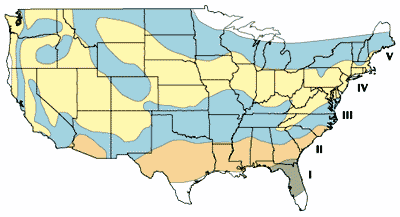
The sizing guidelines Crouch is referring to come from a report issued in March 1996 by the American Gas Association Research Division (AGARD), written by researchers Douglas DeWerth, Robert Borgeson, and Michael Aranov; the team’s work was funded by the Vent-Free Gas Products Alliance and the Gas Research Institute (GRI). The AGARD study used a computer model to gauge the affect of unvented units on indoor air quality and to develop sizing rules-of-thumb that they claim will keep indoor air pollutants below reasonable limits (see Figure 1).
DOE Heating Regions
Figure 1. AGARD’s report supplies rule-of-thumb sizing guidelines for homes in the five DOE heating regions. AGARD also recommends different installations for “tight,” “average,” and “loose” houses — the leakier the house, the larger the recommended unit. The bar chart shows the results of using AGARD’s formula to size a unit for a 24×30-foot room in a house of “average” tightness in each of the heating zones. Marketing spokespeople from the Vent-Free Alliance treat the AGARD study as proof of the technology’s safety. Alliance spokesperson Mary Carson told JLC the study showed that “vent-free appliances have been tested under all kinds of circumstances, and the air quality has matched all of the recommended standards.” In fact, however, early versions of the AGARD report, which were heavily publicized by the gas industry, gave results only for cases where the outdoor temperatures were above 45°F — conditions where the appliances produce pollution levels that satisfy government recommendations. But later versions of the study predicted higher levels of nitrogen dioxide under conditions found in northern regions — too high, in fact, to meet recommendations by some federal and state agencies. In the most recent versions of the report, AGARD has chosen a less stringent standard for some pollutants. In any case, the AGARD results are not based on extensive field measurements. They reflect the output of a computer model which has been verified against only two laboratory experiments, and the figures produced by the computer depend heavily on the input assumptions. While such a computer model can be a useful tool for predicting air quality characteristics, the AGARD study has been widely questioned due to the lack of peer review before publication and the sketchiness of the data reporting. A number of qualified experts and state government officials have criticized the study’s assumptions and conclusions, and regard as premature the vent-free industry’s use of an early draft of the study to influence code bodies and state legislatures. A peer review by Brian Leaderer of Yale University’s John B. Pierce Laboratory is currently underway by order of New York Governor George Pataki, who in 1996 vetoed a bill that would have allowed unvented heating equipment in New York homes. Leaderer has refused, however, to discuss his work with the press until after his report has itself been reviewed and officially released later this year.