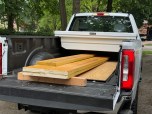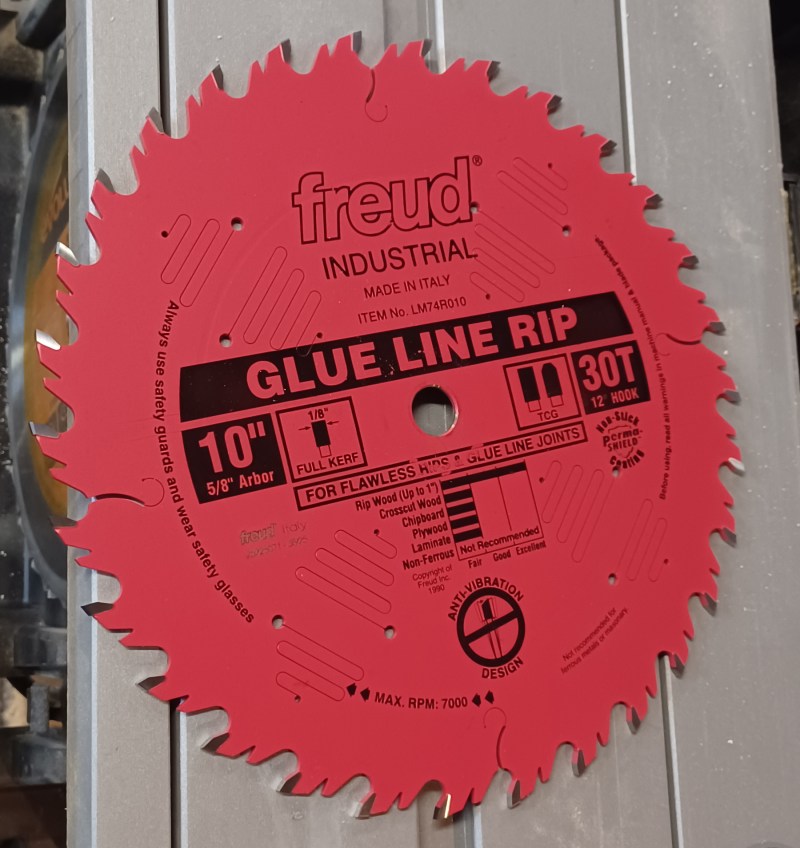
While working with Brian Campbell recently on an article, he turned me on to Freud Industrial’s 30-tooth LM74R010 Glue-Line Ripping Blade. This is not the thin-kerf model, but the full-kerf (1/8-inch-thick) version that retails for around $80. Brian mentioned using it to rip oak and other hardwood boards for a finished edge on stain-grade work without having to run the edges through a jointer. On his recommendation, I bought one in February and have been using it to rip oak stair treads and maple banding for shelves. Without hesitation, I can say I am blown away by the results.
For starters, this blade has transformed my crappy table saw (one I regret buying to replace a beloved Bosch model that was stolen) into a half-way decent tool. I think a lot of that comes from the heavy plate, which is laser cut with squiggly expansion slots that noticeably reduce vibration and sideways movement. The teeth have a triple-chip grind (TCG)—alternating trapezoidal teeth that rough out the cut and flat-top teeth that finish the cut (see photo below). The 12-degree hook is not as aggressive as some blades designed for fast cutting, but it’s in the positive range needed for a ripping blade. And certainly, the feed rate allowed by this tooth design and the full-kerf blade is noticeably slower than many table saw blades I’ve used, even ones with many more teeth. But going slow and steady, the resulting edge came out very smooth. It was completely acceptable to install with only a quick touch with a sander, but that was mostly just to knock the corners down to avoid splinters. Gone were the usual circular saw marks that otherwise only go away with a jointer or power plane, or with way more sanding than I ever care to do.
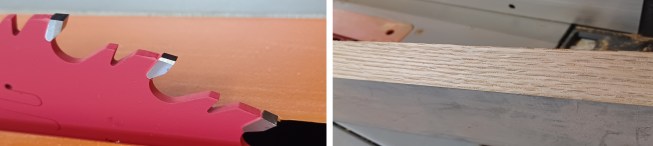
The teeth (left) have a triple-chip grind (TCG)—alternating trapezoidal teeth that rough out the cut and flat-top teeth that finish the cut. The resulting edge (right) only needed a quick touch with a sander, mostly just to knock down the corners.
Some folks on woodworkers’ forums have noted that a glue-line ripping blade is not necessary if you have a well-tuned table saw. But the whole point of my experience is that you can get amazing results on an ordinary or even a cheapo jobsite saw. Yes, a well-tuned shop saw with a thin-kerf rip blade might give you similar results and possibly allow you to cut faster. But for site work, compared to the extra step of jointing (assuming you even have a jointer onsite) or sanding saw marks off the edges of boards, this blade will more than make up for its price and slower feed rate.