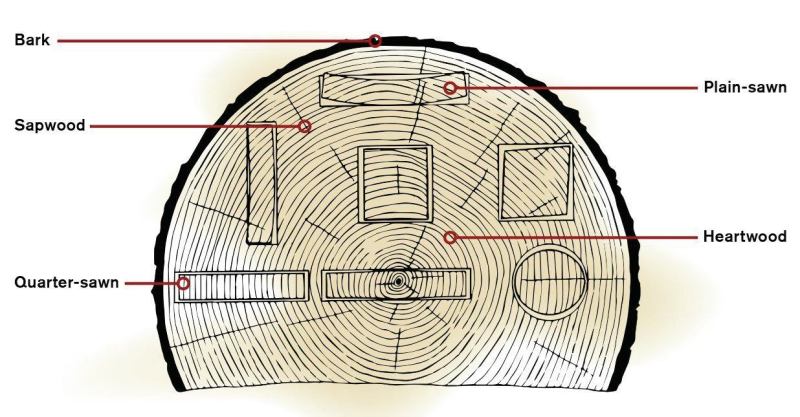
Heartwood is at the center of a log’s cross-section and is usually darker in color than the surrounding sapwood. Heartwood is not “living” wood; its job is to support the tree. As a tree gets older and larger, storage cells in its center die. Various natural chemicals collect there, providing decay resistance—the degree of which depends on the tree’s species, growth site, size, and age.
Sapwood is the part of the tree between the heartwood and the bark. Its main purpose is to transport water and nutrients through its cells from the roots to the leaves. Each year a new layer of wood, continuous from roots to crown, grows around the existing wood (and creates a new tree ring). Sapwood in lumber is susceptible to decay and needs treatment to endure in outdoor service
Plain-sawn lumber (also called flat-sawn) comes from the most common method of sawing logs, which produces the widest boards with the least amount of waste. Plain-sawn boards have a cathedral-grain effect on their faces and a fairly flat arched pattern on the ends. The annual rings range in orientation from being almost parallel with the face of the board to being at an angle of 70 degrees.
Quarter-sawn lumber has a nice straight grain, or vertical grain, on the face. The grain pattern on the ends will range from running perpendicular to the face of the board to running at about 60 degrees from it. Quarter-sawing produces more waste than plain sawing, resulting in higher costs, but quarter-sawn lumber is more resistant to warping with changes in moisture content, and much more stable. In addition, it accepts stains better and more uniformly than plain-sawn lumber and is less prone to checking. If it were always available and in the homeowner’s budget, all my decks would be built with quarter-sawn lumber.
To learn more about wood so you can make better decisions about lumber, see the following:
Return to main article “Wood Decks That Last”