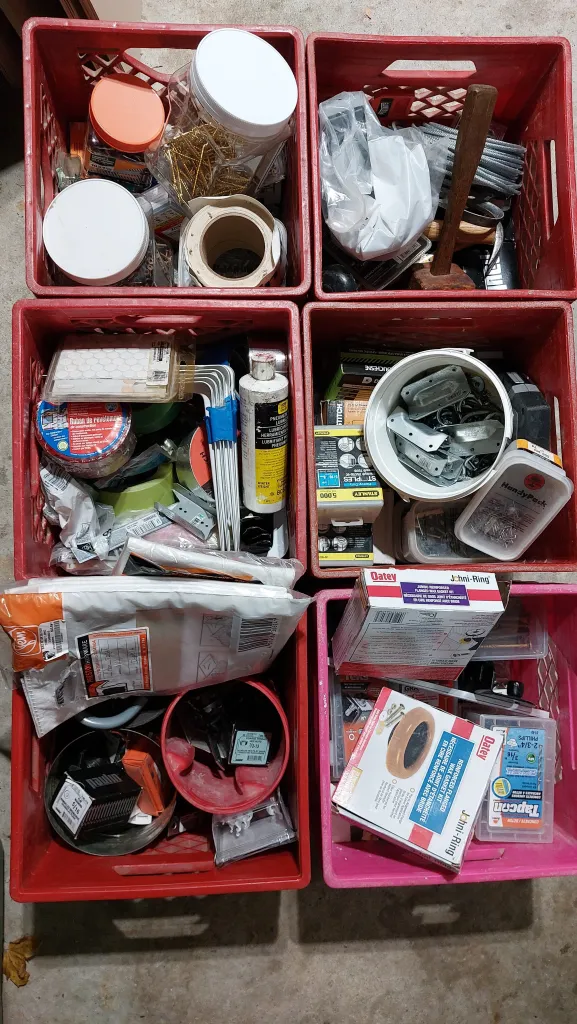
How much ballast have you collected in your life in construction? I know I could equip a small hardware store with what I have accumulated. From talking to many colleagues and contributors I know I am not alone. In my case I spent much of my career as a generalist. One week I was installing hardwood, the next I was framing an addition. I also had a small general contracting business with a friend for years. In that business we also did some minor electrical, plumbing, and HVAC work.
The pile would often be fed like this: I’m at the store and need a braided line for a toilet. Will the 12-inch be enough or will a 16-inch be better? I am a firm believer in “better looking at it than for it” so I buy both. The one I don’t use goes into my extra stock because I am sure I will need it eventually. This same situation gets played out with all manner of things. Very quickly I have enough supply lines to braid a net and enough plumbing fittings for the world’s greatest hamster habitat.
Then comes the tonnage of fasteners! If I needed 3 1/4-inch coil nails, well I would buy a case of course. Buying in bulk is cheaper per unit and more efficient with the extra saved for the next job. In theory this should work out, but there was always overflow. The next job would use up the leftover case and then consume another quarter case. Result: the bulk grows. This repeats with all manner of nails and screws, and that is just the regular rotation items. I swear it breeds.
Then I have the orphans: half a case of roofing nail coils (I haven’t touched shingles in years); the specialized bolts for timbers (a pack of ten but I needed only eight). When was the last time I hand-nailed sheeting? Ten pounds of a 20-pound box of nails are up for grabs if you want to stop by. Also some specialized (and expensive) sealer for natural stone (we needed a few brush strokes, but it only comes in quarts). With these lost souls of fasteners or material the extra left at the end of the job found its way onto a shelf or into a crate, but with little opportunity to use it again.
Another way the pile got fed is all those instances when I could have played archeologist and sifted through the boxes to find an item but going to aisle 12 of the blue or orange home supply store was quicker.
The issue with this mountain of “just in case” or “I’ll use it eventually” is that most of it doesn’t have an expiration date. It also cost money, sometimes a lot for the specialized one-offs. So, I am invested capital-wise and don’t have an end date to use it by. I am also hooked by the memory of that one time when I couldn’t get the item (remember Covid?) but I had just what I needed.
So, beyond the occasional “Ah Ha” moment or the world-spanning pandemic, the pile may get picked at for a project, but mostly it sits.
When my partner and I had the business, we tried to mine the stock as each job rolled to the next. We also started a rule that if we moved something in our storage space twice without using it, then its third move would be to the bin. Now the “bin” items would ideally go to another contractor or donation or recycling center, but some things did just go to trash. What we found was that the time wasted looking for or holding onto something was not worth the effort in keeping it. The better organization and ruthless pruning of the stock kept us from being buried in a cave-in, but a few things still piled up. Things from that time plus another decade now live in my garage and basement and get in my way during the seasonal ebb and flow of my home life.
Talking to a friend at JLC Live, he told me about having to clear out his garage to make space for other storage items and materials. It was a large shell game of stuff between garage, shipping containers, and shed. I felt for him and we both agreed that it was a massive waste of time and mental energy. We also agreed the solution wasn’t more shelving but less stuff.
All that made me realize that while ballast in a ship provides stability, in my garage and in my friend’s garage that ballast is just a burden. It wastes time now and defers organizational effort to the future.
As I write this in May, spring is (very slowly) happening here in Ottawa and it’s time for a spring clean-out. I’ll pass some on to friends, consolidate items to allow for better access, and donate some. Wish me luck as I wish you luck with your hoarded pile of treasure. Then maybe I will look at some of my tools. Why do I have three reciprocating saws and how many drills do I really need? Good god, when did I buy this thing?
Keep the conversation going—sign up to our newsletter for exclusive content and updates. Sign up for free