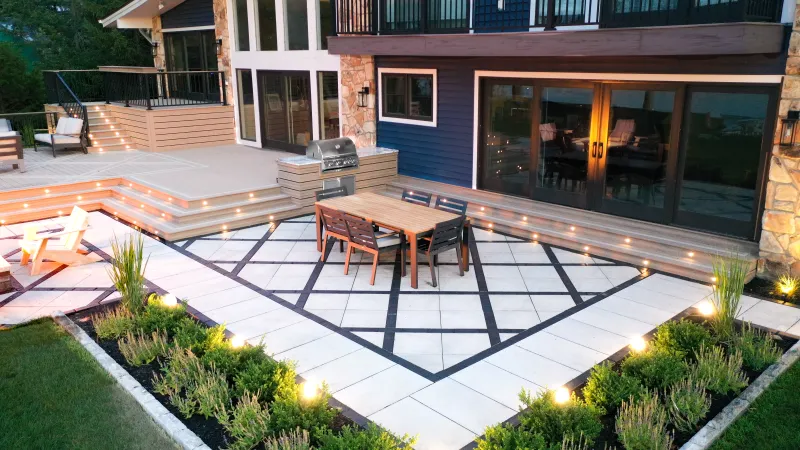
In 2015 I launched a design/build company focused on decks and outdoor living spaces in the Philadelphia suburbs of New Jersey. It was me and one carpenter. I had no experience. Today, I have six employees, including four carpenters. We complete 8 to 10 projects a year that cost $150 to $200,000 each and include decks, patios, roof covers, and landscaping. Having a small number of projects with relatively large budgets means I can focus on doing what I love—creating unique outdoor spaces and having fun doing it—while earning a great living. Work is booked a year in advance.
Contractors are constantly asking me how I built such a focused operation from scratch, and how I keep my pipeline full.
Choosing A Vision
My growth wasn’t just luck. Rather, it came from a deliberate strategy that resulted from an honest assessment of my strengths, weaknesses, and goals.
Prior to 2015, I had a landscaping company with 40 clients. It paid the bills, but I disliked managing that many accounts and wasn’t organized enough to scale it up. My strength is in creativity and design, not logistics. Rather than fighting those tendencies, I decided to pursue a business where they would be advantages.
My father was a contractor, and I had helped him at times, and as a result had some basic skills. I took on an outdoor living project as a side gig and was hooked on the process and the creativity involved. So I sold the lawn equipment and got a contractor’s license. (This is pretty easy in New Jersey. It’s basically a matter of paying a fee and getting insurance.)
That side gig included backyard landscaping and a small deck. I was working for a landscape designer but I did most of the design work, including details like a custom horizontal rail with aluminum rod instead of cables. The experience opened my eyes— there was a market for someone with an eye for design who pays attention to details.
My business plan grew out of that realization. I would start by focusing on design and would let growth come later. And because I wanted to stay small, growth would need to consist of more complex projects with bigger budgets rather than a higher project volume.
Sean Collingsgru
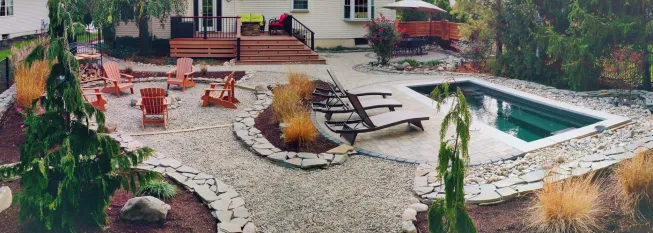
One of the author’s early jobs, this small deck started out as a standard contract job. The outdoor living area was added and built at cost to generate photos to promote the business. This strategy required cutting expenses to the bone for about two years but quickly helped the business become established as a design/build company.
The Portfolio Is Everything
The challenge was that I had no real deck-building experience except for that one job. Despite this, I decided to only accept jobs where the client would give me creative freedom. And I decided that establishing myself as a deck designer would mean forgoing profit at first.
With my first clients, I began by offering to include additional features like custom railings for a very low cost. They would only pay for the materials—I wouldn’t charge for labor. One job was an addition to a cedar deck. We suggested details like a custom railing, bench seating, a design that wrapped around a tree, and a bluestone fire pit. The client didn’t have much money and was thrilled by our offer.
Another early job was a full backyard transformation including stacked stone walls. Here, too, we asked the client to fund only the materials for those extras. We were honest about how we were building a portfolio of completed work, and the clients were okay with that.
Were these financial sacrifices worthwhile? Absolutely. I earned about $10 per hour on those early jobs, but my real compensation was the finished work and photos—which I carefully staged to create a great impression. I put them online and paired them with project stories that positioned me as a creative deck designer.
My first clients came from Facebook and Instagram. I treated my personal Facebook page like a business page, telling people to call me if they wanted something creative in their backyard. Most homeowners want a nice outdoor space but have limited budgets. I was able to give those clients more than they expected and also obtained the photos I needed to build our marketing content around. It was a win for everyone.
New customers didn’t need to know that I was making just enough to survive. What mattered to them was my ability to deliver the results they wanted. The job photos proved to them that I could.
Sean Collingsgru
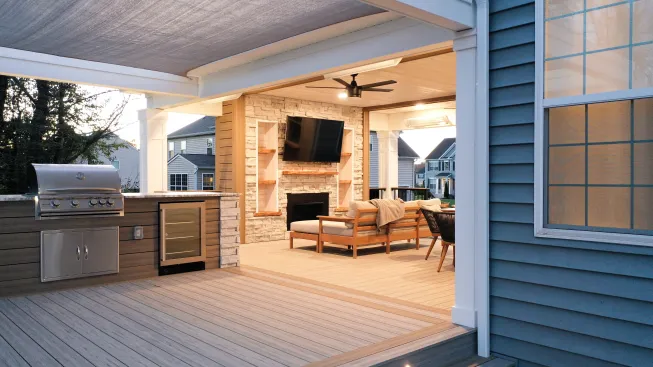
Once the author was established, covered outdoor areas, not just decks, became a staple of the business. This greatly increased pricing and profits. And clients love the small design touches that make an outdoor space feel more like an interior room.
Developing Design Skills
My design education has come from observation. That included postmortems on my own work—I’d walk through a completed project and think, “This space could have used another foot here or maybe a bit less there.” I also pay attention to details as I go through my life. When at a party, I look at how people use outdoor spaces. I’ve learned, for instance, that when entertaining a large group, fewer people sit down than you would expect. So if the clients throw one big party a year they don’t necessarily need a large open space. Instead, they need several smaller spaces with flow and delineation between them, so that on an ordinary day with just the family, they don’t feel like they’re sitting in an empty parking lot.
I also take pictures constantly when at hotels, restaurants, or anywhere else with interesting outdoor designs. In short, I’m always looking for ideas.
After about a year into the business, I had amassed enough visuals to support a website and a social media presence that genuinely reflected the work I wanted to do, and I began getting leads based on that presence.
Cutting Expenses to the Bone
When getting the business off the ground, I made two big commitments: I would trim expenses to the bone and turn down work that wasn’t ideal.
It wasn’t easy to say no to a basic, 12×12 pressure-treated deck that represented quick cash, especially when nothing else was coming in. But saying yes would only have led to other such projects. It would not have attracted the clients I wanted and, in fact, would have worked against the brand I was trying to build. I knew it would take a year and a half to two years for my strategy to bear fruit but I was willing to sit with the anxiety when it appeared.
As for expenses, I’m not the only one to embrace austerity as a business strategy (see “Investing in Your Construction Company: The Pros, Cons, and Possibilities,” by David Gerstel, 11/22), but a lot of the people I’ve talked with seem to view it as radical.
During those first years, I lived in a modest house with a $600-per-month mortgage, drove an older truck (a 1997 Ford F250 that cost me $4,000), and stayed debt-free. I had a tool trailer with basic hand and power tools, as well as a miter saw and table saw. When a job called for a bigger piece of equipment, I would rent it. (The first piece of equipment I took a loan for was a Toro Dingo mini skid loader, but I only did so after the cost of renting exceeded what the cost of ownership would be.)
Minimizing expenses provided the freedom to be patient with the business. It was the biggest factor in my ability to turn down work that didn’t serve the brand I was building.
When I talk with young contractors just starting out, many balk at the idea of running such a lean operation. Most learned the trade by working for another contractor, and of course that’s valuable experience. But a lot of them seem to have internalized a belief that, in order to compete, they need to come out of the gate with a business that’s as close as possible to that of their old boss. So, they borrow $70,000 for a brand-new pickup truck to make an impression on customers.
But loan payments are shackles. It takes longer for a debtor to build an ideal business because they’re forced to accept every job that comes along to maintain that cash flow. I made sure I never got into that position.
Managing Numbers and People
Did I make mistakes during this early period? Of course!
My hyper-focus on the vision led me to shortchange the accounting end of things and so I didn’t have a good grasp of profit and loss. I was reconciling my QuickBooks every month and the numbers were being reviewed regularly by an accountant, but I wasn’t putting in the time and effort needed to learn from those numbers. I was bidding jobs without the knowledge required to accurately price them, which meant I left profit on the table.
I’ve since spent time with my accountant doing postmortems on jobs, have gotten a lot better at the financials, and have become more profitable. Were I starting over, I would do this much earlier.
Another issue that required trial-and-error was how to navigate clients’ emotions. For instance, I had to figure out how to respond if someone had bad taste or an inadequate grasp of how spaces work. Say we have a covered deck with a railing along the edge, and the client asks us to bump out the deck behind where the couch will be a foot more than the plans call for. That could mean needing to extend the roof, or creating an unusable 1-foot space outside the roof line. In cases like these, we talk with the clients about how they will use the space and how they want it to look.
Just as importantly, I’ve learned to manage emotions with prospective clients and to let them down easily when needed.
We’re transparent when it comes to pricing and we offer a free design consultation via Google Meet. Prospects submit photos of their yard and I ask a lot of questions, including how often they entertain, if they like to cook outside, and (this is my favorite) how many people they would likely invite for an impromptu get-together. Based on their answers, we move to the budget. Most people have no idea how much an outdoor project will cost, and this discussion tends to weed out those who can’t afford us. We also let them know that we charge $2,500 for the actual design, which eliminates tire kickers.
Sean Collingsgru
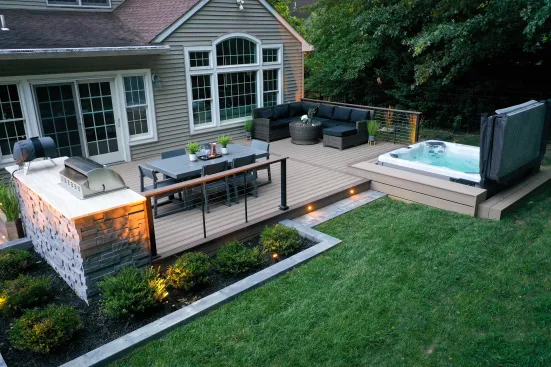
All jobs are professionally photographed for the portfolio. Visual storytelling continues to be a huge factor in how the author attracts new business. Deck size and furniture placement need to support how the clients will use the space. The author learned how to guide them through these choices by attending outdoor events and observing how people actually used outdoor spaces.
And while we actively seek to discourage people who aren’t a good fit for us, we don’t turn them away abruptly, as doing so would give them a bad feeling about our company. A lot of negative online reviews I see are from people who never actually worked with a company, but felt like they were treated dismissively.
On the other hand, providing prospects with something of value leaves them with a positive impression. If we decide we can’t work for someone, I respectfully explain why and try to provide a referral. Or I’ll try to give them some free advice, such as what they should be looking to spend on a project of the size and scope they’re considering, some thoughts on how they might be able to shave costs, or what questions to ask when talking with the next contractor.
People appreciate this type of helpfulness. Some have even recommended us to friends.
The Video Play
After a few years of building the business on photography and social media, I began to see things shifting towards video. I decided to go there, but didn’t want to do it halfway. I wanted a YouTube channel that paid for itself. That would require sponsorships.
However, I continued to be opposed to unnecessary debt, so at first I shot and edited the videos myself. The first year I shot 100 videos and made a total of around $600 in YouTube ads. Not exactly a profit center.
Eventually, however, some videos started to perform well. Once I’d built a consistent audience—around 20,000 followers across platforms—I approached manufacturers whose products I liked to ask them about sponsoring my channel. Once the audience showed up, sponsors did as well. The revenue these sponsorships brought in has been enough to pay the cost of a videographer, who is now a full-time employee.
In 2020 we surpassed a million views and at this point we have 1.3 million followers across platforms. But the foundation of that growth was the fact that we treated our content seriously enough to make it worth sponsoring.
Of course, the media landscape is more saturated than when I started my channel, but there’s still opportunity. The catch is that you need to offer something viewers want. My message to my audience is that we’re a friendly crew having a lot of fun on our jobs, and that seems to resonate with people.
The leads we get from YouTube are almost a side benefit, but the clients who find us that way are pre-sold on working with us. Some of them follow our channel for three years before ever reaching out. The trust factor is enormous for someone considering a large project: People will spend a lot more money with someone they feel they already know and like.
The Business Model, Simplified
What lessons do I believe my experience can offer others? Here’s what it comes down to, as best as I can summarize.
Decide what kind of work you want to do, then focus on building a portfolio that attracts that kind of work. At first, this may mean doing jobs that don’t pay much, but it’s a long-term effort that will demand short-term sacrifices. Keep overhead low enough that you can afford to be patient and to turn down work that doesn’t move you closer to your vision.
Document everything. And look for ways to make your marketing pay for itself rather than just costing you money.
My goal was never to be the biggest deck company in New Jersey. Those 8 to 10 jobs a year I complete are a sweet spot for me. As mentioned above, my growth plan is not to be doing more jobs but to be doing bigger ones with more profit. Our low volume also means I can focus on one job at a time, so I’m able to do work that I’m proud of.
If you’re disciplined enough to stick with a similar program, I believe you can achieve your business goals, too, whatever they are.
Keep the conversation going—sign up to our newsletter for exclusive content and updates. Sign up for free