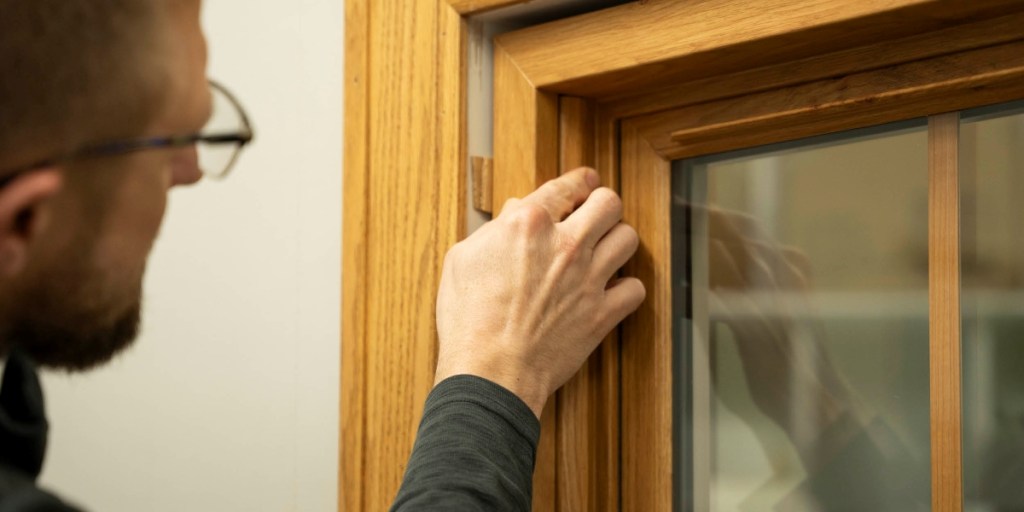
Callbacks from window installation issues aren’t just inconvenient—they can cost nearly five times the original profit, with many problems traced back to small but critical steps like proper shimming.
In fact, shimming has outsized impact on air, water, and long-term function, according to Michael Stutzman, ICP Trainer, Doors and Windows with ProVia. “It’s either spend those five or ten minutes on the front side or risk a potential eight-hour callback,” he warns.
Unfortunately, many installers skip or rush shimming. Issues typically don’t appear immediately—but show up in the cooler months, especially on vinyl windows. “Quite often what I see is that the window will travel through one, two, three seasons, but does not make it through the winter months when the window contracts and shrinks,” Stutzman says.
Here are five best shimming practices that help ensure vinyl window performance—and prevent callbacks.
1. Read manufacturer instructions. Skipping instructions is one of the biggest—and most avoidable—mistakes Stutzman continually sees contractors making.
“The number one breakdown right from the start is just not taking those few minutes to familiarize yourself with the product,” he says. “That’s where shimming locations are missed.”
Stutzman says contractors often skip this step out of pride, but there’s an easy workaround. “What I hear in class all the time is, ‘We’re not going to pull out instructions in front of the homeowner.’ I get that, but you can do it in your truck or do it the day before,” he says.
Instructions are particularly useful because manufacturers regularly test vinyl windows and update guidance accordingly. “These are all things that have been field tested to work in the real world,” he says.
2. Get shim placement right. Shims anchor the window to the framing and control how it behaves over time. They’re even more important with vinyl windows because vinyl contracts and expands more with temperature changes. “We have to somehow solidify the window unit to the house and how we achieve that is various shim locations,” Stutzman says.
Most manuals call for a minimum of 12 inches between shims. For a 56-inch-tall window, this equates to five locations per side vertically. Stutzman says the most important thing to remember is to avoid placing shims within 4 to 6 inches from the corners.
“We want that expansion to happen in the corners,” he explains. He adds that one of the most critical shim locations is at the window’s interlock area—where the meeting rails lock together when closed.
3. Ensure the window is square and plumb. Whether it’s a nail fin or not, shims are vital to proper alignment within the pocket.
Consistent margins are crucial. When setting the window unit in the opening, check the spacing between the top and bottom sash and the frame, as well as the side margins. Visually confirm that the margins are even vertically and horizontally, then use shims and jamb screws as needed to keep the unit square and plumb. (see illustration for reference)
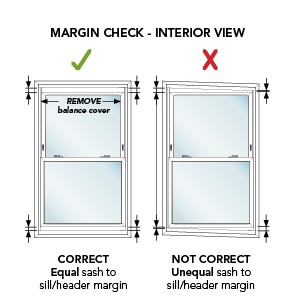
“You’re letting the window tell you what needs to happen to make it function properly and to set those vertical margins true,” Stutzman says.
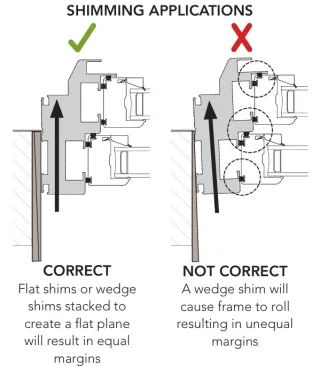
4. Avoid over- and under-shimming. The goal is creating consistent support without distorting the frame. “You want that weather stripping to be compressed but not over compressed,” Stutzman says.
Over-shimming causes excessive resistance in sash operation, while under-shimming leads to partial frame support, air infiltration, and eventual frame roll.
One of the biggest mistakes installers make is using wedge shims rather than back-to-back or opposing shims. Sliding two shims against each other with opposite tapers creates a flat, consistent surface that fills gaps and properly secures the window frame.
“That wedge shim worked in warm weather, but now that it’s cold, the window wants to contract and that wedge shim isn’t enough,” Stutzman says.
5. Account for vinyl movement. Vinyl will move, but good installs allow for this by maintaining proper shim spacing and letting expansion happen at the corners, avoiding problems such as frame bowing or rolling.
“The goal is we want that movement to go to the corners. That’s where we don’t have issues with movement,” Stutzman says.
Window color is another variable to consider. Today’s products come in many colors beyond white, and darker colors absorb more heat—meaning more movement.
“So often when we get callbacks it’s on the dark colored windows because the installer just didn’t respect how that darker color is going to have more movement,” Stutzman says.
For more information, please visit provia.com/windows.