- Q. What causes truss uplift and how can it be prevented?
- A.Henry Spies responds:Truss uplift is caused by differential shrinkage between the upper and lower chords of a truss. In a well-insulated house, the bottom chord is buried in ceiling insulation. In the winter, that chord is kept much warmer, and tends to dry to a lower moisture content than the top chord, which is exposed to the ventilated attic air. This dry bottom chord shrinks. Most of the shrinkage takes place across the grain, but there is some lengthwise movement as well.
In a triangular structure, such as a truss, if the bottom member of the triangle is shortened while the two top chords remain the same length, the peak of the triangle rises, pulling up the bottom chord, which is attached by webbing or a king post. As the ceiling rises, unsightly corner cracks may open up. If the partition is firmly attached to the bottom chord, the partition may even be lifted off the floor deck. This is not a structural problem, just a cosmetic one.
In the summer, when the temperature and moisture content of the top and bottom chords are nearly the same, the truss will come back to its original position, closing any cracks that have formed. In many instances, this cycle will occur only once. In others it will occur on an annual basis.
How can you keep this from happening? You can’t fool Mother Nature. A truss manufacturer can select chord members that come from the outer parts of the tree, which helps. The “juvenile wood” near the center of the tree moves more with changes in moisture content than the mature wood. But the most practical thing a builder can do is to use details which will prevent the cracks from showing.
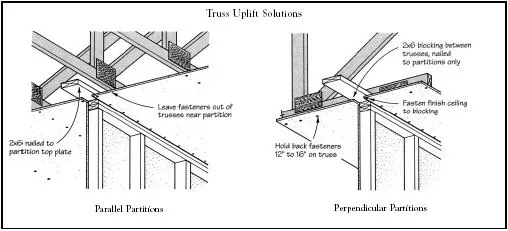
A connector such as the Stud Claw can be used to connect the top plate of an interior partition to the truss. A single nail that slides in a groove is tacked into the bottom truss chord, allowing the truss to move vertically with seasonal changes. The ceiling drywall should not be nailed to the bottom chord of the truss within 19 to 16 inches of an interior partition. Instead, it can be supported by corner clips nailed to the wall studs, by a drywall backing angle, such as the material made by Trim Tex, or nailed to a wider top plate, as shown in the illustrations. This allows the drywall to flex in the 16-inch space between the last nail in the chord and the partition. The corner is held solid, so the tape does not break. The deflection of the drywall is usually unnoticeable.
— Henry Spies is a building consultant formerly with the Small Homes Council-Building Research Council of the University of Illinois, and the Q&A columnist for JLC.