Download PDF version (627.5k) Log In or Register to view the full article as a PDF document.

Image

The purpose of fire blocking is to prevent fire from spreading through the concealed spaces of a building. It works by dividing framing cavities into separate compartments, slowing the passage of flames and combustion air.

In an unblocked balloon-framed building, for example, a fire that starts in the basement can rapidly travel up the stud bays and spread into the joist bays and attic. In a platform-framed structure, though, the top plates separate stud bays from joist bays. This means a fire that starts in a wall cavity would have to burn through the plate to enter the joist bay above. But if something short-circuits the fire blocking — if, for instance, you install a soffit without separating it from the wall cavity — fire is free to travel up the stud bay, through the soffit, and into the joist bays.

As a framer, I have to install fire blocking regularly. Doing this correctly can get tricky, depending on the complexity of the building. To avoid the delay and expense of inspection tags, I always pay special attention to fire blocking, making it a point to look for places where the inspector might require it.

I work under the IRC. Unless otherwise noted, all code references in this story are from the 2006 IRC.

Interpreting the Code

Section R602.8 of the IRC states, “Fire blocking shall be provided to cut off all concealed draft openings (both vertical and horizontal) and to form an effective fire barrier between stories, and between a top story and the roof space.” The section goes on to list a number of locations where horizontal and vertical cavities might connect — in the enclosed area around stair stringers, for instance, and at cove ceilings, drop ceilings, and soffits. Chimneys and fireplaces are also cited. Listing every single place where fire blocking might be required is impossible; the best strategy for builders is to understand the code’s intent well enough to figure out where fire blocking is needed — before the inspector has to flag it (see illustration).

Image

Approved materials. Only certain materials can be used for fire blocking. Of the items listed in the code (R602.8.1), the ones we use most commonly are 2-by lumber, 3/4-inch structural panels, and 1/2-inch drywall. Unfaced fiberglass and mineral fiber batts are also approved if they “fill the entire cross-section of the wall cavity to a minimum height of 16 inches” and are securely installed so they can’t move. (The 16 inches would be measured down from a soffit and up from a tub deck.) But in my experience, inspectors tend to prefer solid materials and would not be likely to accept the use of batts.

Types of Fire Blocking

Most carpenters think of fire blocking as short scraps of 2x4 or 2x6 nailed horizontally in stud bays. While we do use lots of short blocks, there are also places where a single piece of lumber or plywood will achieve the same result. Since the cost of labor goes up with the number of pieces installed, we always try to use as few individual members as possible.

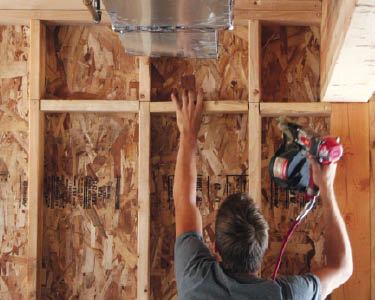
A good example of this is soffits, which we always frame before the drywall is installed: Instead of installing an individual block in every stud bay along the wall, we run long pieces of 2-by or 3/4-inch sheet material across the face of the studs before framing the soffit (see Figure 1). As long as this piece is wide enough to reach all the way to the top plate, there’s no need to install blocks in the bays.

Image

Image

Figure 1. The author uses a single 2x10 fire block nailed to the face of the studs for this kitchen soffit — much faster than installing individual blocks in the stud bays (top). Scraps of OSB rim board isolate a dropped ceiling (bottom) from the stud cavities on its left and the stair stringers beyond.

The same is true for dropped ceilings. Even if the finished ceiling is a foot or more below the floor joists above, we find that running a band of sheathing or drywall around the perimeter before hanging the ceiling joists is more efficient than installing individual blocks in the stud bays.

Draft Stopping vs. Fire Blocking: What’s the Difference?

While fire blocking is intended to separate vertical assemblies from horizontal assemblies, draft stopping restricts air movement within large horizontal assemblies. The IRC (R502.12) states, “When there is usable space both above and below the concealed space of a floor/ceiling assembly, draft stops shall be installed so that the area of the concealed space does not exceed 1,000 square feet. Draft stopping shall divide the concealed space into approximately equal areas.”

In most residential floors, which are typically framed with I-joists or solid lumber, the largest concealed space is a single joist bay — nowhere near 1,000 square feet of area. But with open-web floor trusses or a dropped ceiling, there could easily be more than 1,000 square feet within the concealed cavity between a drywall ceiling and the subfloor above.

Draft stopping breaks this area into smaller compartments so that a fire would spread less quickly. With open-web joists, the usual method is to subdivide the space by sheathing the side of the truss with drywall or plywood; with a dropped ceiling, you would have to build a soffit or some other kind of divider.

As if this weren’t confusing enough, there’s another related category referenced in the codes: A “fire stop” is a material or device designed to maintain the fire-resistance rating (in hours) of fire-rated assemblies penetrated by pipes, wiring, and mechanicals. To be classified as a fire stop, the material or device must pass ASTM E814 or UL 1479. Fire-rated assemblies are common in commercial and multifamily buildings but are rarely required in single-family homes. — David Frane

Rake Walls

As I mentioned above, the top plates used in standard platform framing act as fire blocking, so for the most part we don’t need additional blocks in walls. One exception is rake walls, which we typically frame using full-height studs running from the floor deck to the sloped top plate. Under an earlier state code, we had to install fire blocking every 10 vertical feet in these tall bays. That rule has been dropped, but we still have to block where a flat ceiling or attic floor meets the rake wall. With cathedral ceilings, the double top plates serve as fire blocking.

Knee Walls

How to handle upper-story knee walls depends on whether they’re drywalled on the back — as in a knee-wall closet — or left open, in which case the area behind them is considered part of the attic.

When the design calls for finished storage space behind knee walls, we frame them with top plates. If the area behind the wall will not be finished, we usually just nail the studs to the sides of the rafters. But there’s no need to fire block the bays, because the entire space behind the wall is considered unfinished attic.

Basement Walls

If the house has a basement, we typically frame a 2x4 stud wall inside the perimeter, holding it away from the concrete foundation about an inch or so. Even when there’s batt insulation in the bays, the back of the wall would be open at the top where the plate attaches to the joists — which means that by code fire blocking is needed.

The easiest way we’ve found to fire block this spot is to butt a continuous 2x8 to the mudsill, letting it overhang the foundation wall. We nail the 2x8 to the floor joists above, then nail the 2x4 top plate of the basement wall to the 2x8.

This technique serves another purpose too. Since the mudsills are straight and square, the overhanging 2x8s are also straight and square. We quickly plumb down from the 2x8 edge with a laser to lay out the bottom plates of the 2x4 walls, which gives us a perfectly straight, square layout without any fuss.

Separating stud bays. Because of the air space behind them, our basement walls trigger a second code requirement: R602.8 (item 1.2) states that fire blocking is needed “horizontally at intervals not exceeding 10 feet” within concealed spaces in stud walls. The rule is intended to prevent all the bays in a wall from being connected when the studs are not drywalled or sheathed on both sides. (This condition also occurs in double-framed walls, or where strapping is used to flatten a wall or ceiling.) We meet the requirement by sistering 2-by material to the sides of studs and running it back to the foundation. This blocking isn’t pressure treated, so we hold it off the concrete and get the insulator to caulk the gap when he seals and insulates the wall.

Sealing Penetrations

A new provision in the 2006 IRC (R602.8, item 4) states that fire blocking is required “at openings around vents, pipes, ducts, cables, and wires at ceiling and floor level, with an approved material to resist the free passage of flame and products of combustion.” This means you have to seal around all those wires, pipes, and ducts that run through top plates and subfloors. Energy-conscious builders often do this anyway, as an air-sealing measure. But if you work under the 2006 IRC, you now have to do it with an approved fire-blocking material. A similar requirement has long existed for fire-rated assemblies in commercial projects.

Just what constitutes an “approved material” for sealing these openings is subject to debate. Few materials that work for this purpose are prescriptively approved — that is, specifically named in the code. But materials that are not prescriptively approved may be approved as “alternative materials and methods.” Under R104.11, a material can be used if the building official finds that “the proposed design is satisfactory and complies with the intent of the provisions of this code, and that the material, method, or work offered is, for the purpose intended, at least the equivalent of that prescribed in this code.” In other words, it’s up to the building official.

Tested materials. One way to get an inspector’s sign-off is to submit an ES report — a document issued by the ICC Evaluation Service (a subsidiary of the International Code Council) that shows the material in question has been third-party tested for code compliance. An ES report lists the test standards the product has met, the regulations it complies with, and the conditions under which it can be used. While an ES report is often convincing, it doesn’t guarantee that the inspector will accept a particular product.

Nearly every inspector will allow you to seal penetrations with intumescent and noncombustible sealants of the type used in “approved penetration fire-stop systems” tested to ASTM E814 or UL 1479 (R317.3.1.2). This is a higher standard than must typically be met in residential construction, where fire-rated assemblies are rare.

Image
Image

The red caulk around these pipes (top) is approved for use in fire-rated assemblies. The orange polyurethane spray foam around the ducts (above) is not intended for use in fire-rated assemblies, and may or may not be accepted by building officials for sealing penetrations through fire blocking.

Unfortunately, because fire-rated caulks are expensive ($8 to $16 per tube), many builders prefer to use the cheaper canned spray foams now being marketed as approved fire blocking. These foams are typically dyed orange so they can be easily identified by the field inspector, and they have ES reports indicating that they work as fire blocking. The problem is that “fire block” foam is tested to a modified version of ASTM E814, not the more stringent standard used for caulks in fire-stop assemblies. The fact that the foam will ignite may pose a problem for some inspectors. — David Frane

Stairways

Most carpenters are accustomed to putting sloped fire blocks in the stud bays alongside stair stringers (Figure 2). What not everyone realizes is that this blocking is necessary only if the stud bays are open to a concealed space below the stair. But if the area below the stair is accessible, the bottom of the stringers and the walls below the stair must be covered with 1/2-inch drywall (R311.2.2). In that case, there’s no longer a need to install the sloped blocks in the bays, though many framers do it anyway, out of habit.

Image

Figure 2. Sloped blocking beside the stringers and horizontal blocking at the landing separate the concealed space below the stairs from the stud bays above.

The enclosed space between the stringers must also be separated from the joist bays at floors and landings. The subfloor takes care of the bottom, but the top will probably need to be blocked. This is another place where we often use a single strip of sheathing or lumber, as seen in the bottom photo in Figure 1.

Image

Figure 3. To separate the chimney chase from the attic, the author installs a 3/4-inch OSB fire block at the level of the ceiling. A metal fire stop fills the gap that is required between flue and OSB.

Flues

The houses we build contain manufactured fireplaces, so we don’t have to deal with masonry. We follow manufacturers’ installation instructions, but always hold framing back at least 2 inches from flues, per code. When we frame chimney chases, we install a 3/4-inch plywood or OSB lid at each ceiling the flue passes through (Figure 3). The fireplace installer cuts an oversize hole in the lid, runs the flue through it, and then closes the 2-inch gap with a metal fire-stopping ring.

Tim Uhler is a lead framer for Pioneer Builders in Port Orchard, Wash., and a JLC contributing editor.