
As a design-build contractor specializing in custom homes near thewater, I have to take wind loads into account on every project. The New England coastline where I work has been hit by hurricanes before and no doubt will be again; homes here are supposed to be ready to handle a storm.
I’ve been using wind-resistant design and construction details for as long as I’ve been a builder, but this year I’ve been making some adjustments. That’s because I face the same situation as many builders in other coastal states: Rhode Island and Massachusetts, where I work, are moving to the 2000 International Residential Code (IRC) and the International Building Code (IBC). The International Codes contain provisions for wind-resistant construction that are quite a bit tougher and more detailed than the rules we used to have.
Even for builders like myself who have long experience with wind-resistant details, now is a good time to review our approach to wind-resistant construction. If you don’t know much about wind issues, and you plan to build near the coast, doing some homework will help you stay out of trouble.
The new rules cover a whole range of complicated issues, including the way houses are anchored to foundations and the way components and claddings are attached to the structure. There’s also a new set of requirements for windows. That’s too much to cover all at once, so in this article I’ll focus on one aspect of a wind-resistant building: shearwalls.
Understanding Wind Loads
Every framer has an instinctive awareness of gravity loads: Common sense says that your walls have to hold up the floors and the roof. Lateral loads aren’t so obvious, but near the coast they are important: Wind applies a sideways force to your building that can be stronger than the gravity loads on the floors and roofs. The Rhode Island waterfront house shown in this article, for example, had design wind pressures of 35 psf on the building. That house needed several beefy interior shearwalls to pick up the load.
Wind acts on a building’s structure in several primary ways. Uplift, the suction force that could tear the roof off or lift the building off its foundation, is important to consider, but it’s not central to this discussion. What matters more here are the racking, sliding, and overturning effects: When winds try to roll the house over or slide it horizontally, floor diaphragms and shearwalls come into play.
In reality, the force of wind is variable and unpredictable, and there is no way to define it exactly. To get numbers we can use for design loads, we have to oversimplify. In the code, it comes down to wind speed zones: The higher the wind speed zone, the greater the pressure. There are also exposure categories: If you’re building right on the water where wind has a clear shot, you use a higher-design wind load than if your site is protected by woods, rough terrain, or other buildings.
Shearwalls at Work
How do shearwalls handle wind? The easiest way to understand wind is to think of it as a constant load pushing against a wall face. It loads the wall the way furniture and people load a floor, only horizontally rather than up and down. Wall sheathing collects the wind pressure and delivers it to the studs, which in turn carry the load to the top and bottom of the wall and apply a force to the floor systems. Next, the plywood-sheathed floor picks up the force, acting like a deep, thin, sideways beam, and carries the load over to the shearwalls. The shearwalls, in their turn, restrain the floor diaphragm and carry the load to the foundation and into the earth. On larger buildings, end shearwalls typically need help from interior shearwalls.
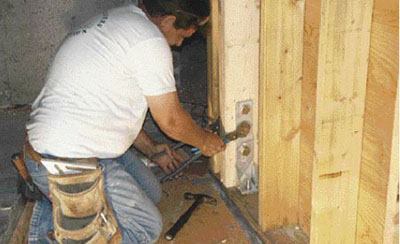
To do their part, the shearwalls have to be stiff enough to resist racking, and they must also be anchored against sliding and overturning. The stiffness comes from plywood or OSB sheathing (I use plywood). To pin the wall in place, the easy choice is a manufactured hold-down like Simpson Strong-Tie’s HD5 series, which I used on my current Rhode Island project. You could design your own connector if you could find an engineer to okay it, but in my experience it’s so convenient to work with Simpson products that I don’t bother looking for an alternative.
Stud and plywood framing isn’t the only way to build a shearwall. In commercial construction, engineers might call for a steel moment frame or a reinforced masonry shearwall to pick up lateral loads. But steel and masonry aren’t easy to mix with wood framing; they interfere with wiring, insulation, flashing, and everything else. In houses, wood-framed shearwalls make more sense.
Even without special detailing, a stud wall with plywood or OSB sheathing has a lot of shear capacity. A “braced wall section” that will satisfy the IRC prescriptive path is just like a normal sheathed wall. It’s permitted in lower-wind-speed zones. But it’s not an engineered solution — code acceptance of braced wall sections is based on tradition and experience.
To get an actual shearwall with predictable strength, you don’t change much: It’s still 16-inch on-center stud framing with a single shoe and double top plate, typically sheathed with a 1/2-inch panel (or thereabouts), using 8d nails. But you need hold-downs of some sort at both ends of the wall — concrete anchors, or a floor-to-floor connector in the case of a second-floor shearwall. The hold-downs need to connect to a double stud, or sometimes even a single 4×4 member.
To strengthen the basic shearwall, you can increase the perimeter nailing, use thicker plywood, or go up to 10d nails — or some combination of all three. If the wall has to handle a bigger load, it may also need beefier hold-downs. Specifications that match nail size, spacing, and panel thickness to shearwall allowable capacity are available from APAThe Engineered Wood Association at www.apawood.org.
New Codes, New Loads
While design and construction of shearwalls have not changed, the codes that tell you where and when you need a shearwall have. Based on the lessons of hurricane damage in the 1990s, the IRC and IBC have incorporated a number of important changes. One is that the map of wind-speed zones has been modified to reflect new data collected by modern instruments. The new map is published in ASCE-7, the American Society of Civil Engineers handbook that governs wind and seismic building design.
The IBC now requires houses in wind speed zones greater than 110 mph to be designed according to ASCE-7, or according to one of the documents based on it (see ” For More Information,” below). If your house is exposed to a wind speed of less than 110 mph, you can use the prescriptive methods given in the IRC, and for speeds of less than 100 mph, the prescriptive methods give you more leeway. Below 90 mph, conventional construction is allowed.
Of course, states that adopt the IRC and IBC can (and do) amend them, adding their own special rules and compliance paths. In Rhode Island, for example, the state has tried to simplify even the prescriptive wind provisions in the IRC. In place of the IRC’s extensive section on “braced wall” options, Rhode Island’s “Appendix L” just calls for a 4-foot-wide shearwall at every building corner and at least every 25 feet — blocked at panel edges, nailed at 6 inches on-center, and with an anchor and doubled studs at each end. (Alternatively, a window opening may occur as close as 2 feet from the corner, but only if the shearwall section is made 8 feet wide instead of 4.) It’s simple, but if you deviate from it, you need an engineer to review and approve the change.
I don’t particularly like the limits on window location or the prescriptive tables they replaced. I never use the prescriptive methods, even if I’m in a zone where they apply, because I know that at some point I’m going to want a window or something where the rules don’t allow it. So I just get an engineer on board from the beginning and assume that he’ll be reviewing the plans. That way I can control both the appearance and the structure of the house.
Designing Around Shearwalls
Near the water, I like to use the shingle style, a tradition that includes a lot of jogs and bays. The corners and short wall sections add rigidity to the structure.
I always identify the shearwall requirements at the beginning, before I start to make decisions about the floor plan. When I see that I’m going to need interior shearwalls, I can place walls that define the shapes of rooms in the house in a way that lets me use those same walls for shearwalls and also as bearing walls for the roof and floor gravity loads. It simplifies both the engineering analysis and the construction of the house, eliminating a lot of aggravation and expense.
To simplify the structural analysis, it’s helpful to locate a few wall areas in each structure that can be left without windows. That way I don’t have to analyze walls with openings (“perforated” shearwalls). Instead, I have the freedom to slide windows around any way I please in all the other walls.


