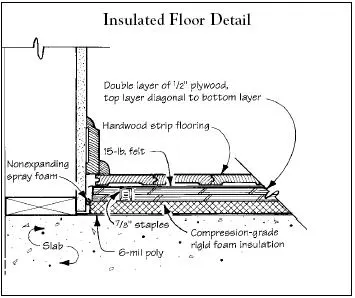
- Q. We are looking for a detail for laying a wood floor over a previously uninsulated slab. What’s the best way to go about this?
A.Howard Brickman responds: The best way I’ve found is to build a floating plywood floor over foam, then apply strip flooring over this (see “Laying Wood Floors Over Concrete Slabs,” 10/94). Depending on how much foam you use, you will raise the floor level several inches.
Under any floor on a slab, I first lay down a double 6-mil poly vapor barrier, taping the seams at the overlaps and extending the edges up the walls. Next I lay down the foam, keeping it as flat and firmly supported as possible.
Cut the foam about 1/4 inch shy of the wall and seal the gap with a squirt of spray foam. If you prevent the foam from moving, you’ll avoid squeaks in the finished floor later. The concrete should be flat with no variation greater than 1/4 inch over 10 feet when checked with a straightedge. This means that if you’re retrofitting an old garage into new living space, you’ll have to deal with the slope in the floor, preferably before installing the vapor barrier. Pouring a thin layer of concrete to fill in the low spots is probably the best way.
Also, use a compression-grade extruded polystyrene foam that will support the weight of the floor, furniture, and occupants. One type of compression-grade foam is Styrofoam “greyboard.” Tape the joints between the tongue-and-groove foam panels to minimize any movement or shifting that could cause noise.
When you have a stable foam base, place a layer of 1/2-inch plywood parallel to the long dimension of the room. Space the panels about 1/4 inch apart, and leave at least a 1/2-inch space around the perimeter (see illustration at right). Do not glue the plywood-to the foam. Then lay a second layer of 1/2-inch plywood over the first, orienting the panels 45 degrees to the first layer. Space this layer the same distance apart as the first layer, and screw or staple the two layers together.
Over this floating wood “slab” and the usual layer of 15-pound building felt, you can lay down your strip flooring.
Howard Brickman is a hardwood flooring contractor in Norwell, Mass.
Q&A: Insulated Wood Floor Over Concrete
Insulated Floors Over Concrete
2 MIN READ