Brick veneer poses few structural problems, as long as it can support its own weight all the way down to the foundation, or is supported by properly sized steel lintel angles at door and window openings. But introduce more complicated conditions — a bay window that projects from the main exterior wall, say, or even something as common as a two-car garage door — and brick veneer can start to look like more trouble than it’s worth.
As a case in point, how do you support the brick when a lower one-story garage roof meets a two-story wall, with brick on the common wall above the garage roof?
Several JLC readers have posed this question, having seen examples where builders doubled up the roof trusses directly below the brick, then laid the brick directly on the roof deck. I don’t recommend this approach, because rafters and trusses carrying the weight of brick would typically not have adequate strength or stiffness to meet most codes. Also, the roof framing will move at a different rate than the wall framing that the brick is anchored to, which could cause visible cracking in the mortar joints.
Using Steel Angles
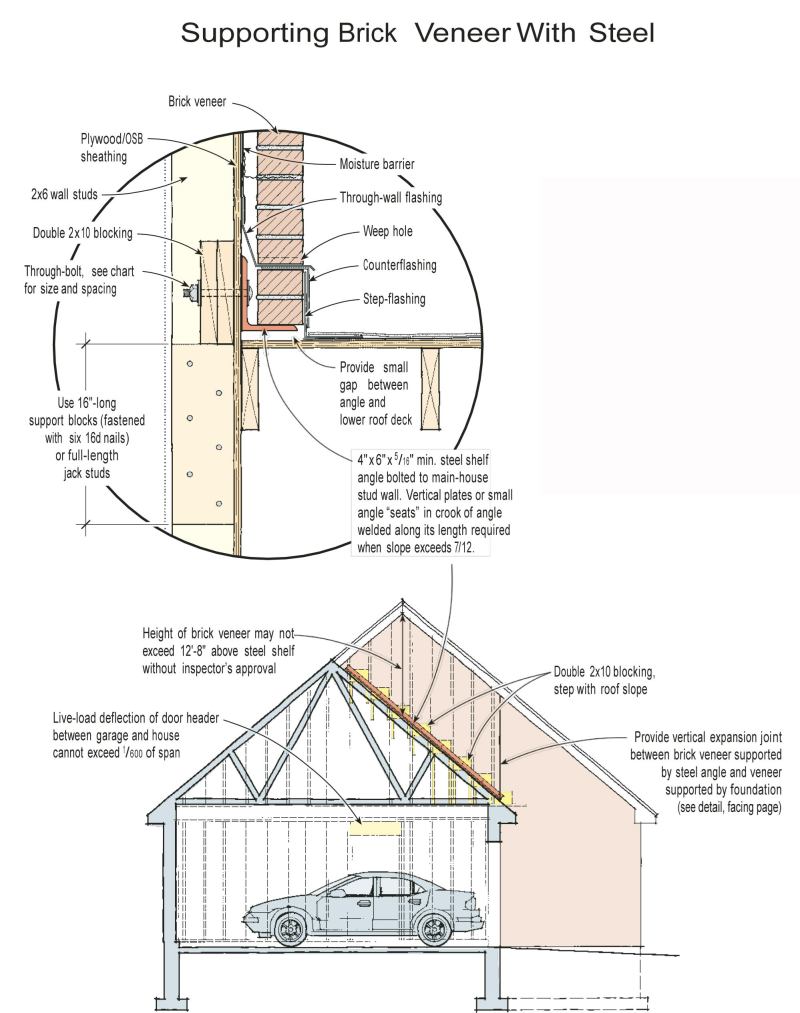
A better solution is to support the brick above the garage roof with a steel shelf angle bolted to the stud wall at the main-house wall.
Supporting Brick Veneer With Steel
According to the 2006 IRC, this 5/16-inch (minimum) steel angle should measure at least 4 inches by 6 inches, with the long leg oriented vertically and anchored to the framing (see Section R703.7.2). The angle should be set to follow the slope of the roof, with a small gap between the horizontal leg of the angle and the roof deck.
To make installing the brick a bit easier, the steel fabricator should add vertical plates in the crook of the shelf angle at intervals along its length, which will resist the brick’s tendency to slide down the slope of the angle.
Another option would be to weld small angles onto the horizontal leg of the primary, sloping angle; this will create a series of small steel seats or terraces that the brick can be started on. These stops are required by code whenever the slope of the roof exceeds 7/12.
For brick veneer to be supported by wood framing in this way, the IRC has a few requirements. First, the veneer must not weigh more than 40 pounds per square foot, which shouldn’t be a problem with standard bricks but could be one with thicker jumbo brick or stone.
Second, when the height of a brick-veneer wall above a steel angle exceeds 12 feet 8 inches, the design must be approved by your building inspector.
Third, if the brick is supported by a beam or header (for example, if there is a door opening between the garage and house), the live-load deflection of the header cannot exceed 1/600 of the span length. In this case, live load applies not only to the normal forms like snow on the roof, furniture on the floor, and people at a party, but also to the weight of the supported brick itself.
The point of this requirement is to limit deflections that might cause cracking of the brick.
Fastening Steel to Framing
While building codes permit the use of lag bolts into doubled studs, I prefer to through-bolt the shelf angle into double blocking between the studs. This connection is stronger, and it’s easier to hit blocking (rather than the center of a stud) when drilling holes through steel and sheathing. There’s a more reasonable margin for error if you step the blocking down with the slope of the roof and lay out bolt holes between the studs.
This blocking needs to be adequately supported. If you simply toenail or through-nail the blocking in place, the force from the bolt could overwhelm the nails, and the blocking could slip down the wall. So think of each double block as a little header between studs, with jack studs supporting each end of each block.
If the block is close to the floor, run the jack studs all the way down to the sill and fasten them to the wall studs with a few nails to lock them in place. If the block isn’t close to the floor, pairs of 16-inch-long jacks fastened to the studs with six 16-penny nails will handle more load than any one bolt can carry.
The appropriate bolt size and spacing depends on how much brick veneer is to be supported by the steel angle. When choosing a bolt size and spacing (see chart), keep in mind that smaller bolts spaced closer together are easier to install than larger bolts spaced farther apart, and are structurally superior.
Flashing and Movement Joints
Waterproofing should consist of normal weep holes and flashing at the base of the brick, coupled with step-flashing and counterflashing directly from the roofing to the brick veneer — similar to how you’d flash a chimney. This detail can make the transition at the eaves a little tricky, but simplifies reroofing.
A final requirement — one that many builders seem to skip and many building officials don’t seem to be aware of — calls for vertical expansion joints to separate brick supported by wood framing from any adjacent brick that is continuous to — and supported by — the foundation.
To create a proper vertical expansion joint, lay up the brick with a continuous unmortared vertical joint, then finish it with a continuous flexible backer rod and compatible sealant.
These joints will ensure that whatever small movement does occur in the brick over the garage will not cause cracking at the transition to the adjacent brick supported on the foundation.