by Fred Ambrose
Our company specializes in oceanfront construction and rehab
in southeastern Massachusetts. We do our own foundation work
because of the control it gives us over the schedule. In some
parts of this area, digging down is likely to uncover a mushy
mix of sand, peat, and clay, not to mention a high water table.
Since these soil conditions won’t support a conventional
concrete foundation, local homes have traditionally been built
on wood pilings, which allow floodwaters to wash in and out
freely without undermining the structure.
The job shown here involved replacing a rotted piling
foundation. The house stands along Provincetown’s
historic harbor, where it’s common for 19th century
buildings to be separated by only a few feet. This crowding
leaves little or no space for conventional excavation; besides,
trenching in the loose sandy soil risks undermining neighboring
houses.
So for this job we decided to use helical piers, which looked
to be an ideal solution because they require no excavation and
can be driven quickly even in tight quarters (see
“Helical Pier Foundations for Problem Sites,”
5/04). We obtained certification in the Chance Helical Pier
Foundation System (573/682-8414,
www.abchance.com) and
purchased the equipment needed for installation, which included
a hydraulic auger adapted to our excavator’s boom and a
computerized torque meter. Altogether, it cost around
$8,000.
Engineered Design
To design the foundation, we called on structural engineer
John Bologna of Coastal Engineering Co., a firm familiar with
the local geology and structural requirements. His knowledge of
surrounding properties led John to expect alternating layers of
sand, peat, and clay, with water at 4 feet below grade.
Based on this information, he specified a reinforced concrete
grade-beam footing supported on helical piers spaced about 9
feet apart and driven to a minimum depth of 22 feet (see Figure
1). On top of the grade beam, a 10-inch-thick stem wall would
support the new floor framing. Flood vents in the stem wall
would allow high water to wash in and out, preventing the wall
from collapsing in a surge.
Figure 1. Grouting adds surface area and lateral
friction to the column, increasing its capacity. It also adds a
layer of protection against corrosive soils.
House Overhead
A major consideration was how to install the pier-and-beam
system beneath a structure that couldn’t be accessed from
all sides or raised and moved aside. The neighborhood’s
historic classification barred complete demolition and
replacement of the house, certainly the easiest approach.
Instead, we raised the house 4 feet, lifting it by the
first-floor ceiling joists. We then cut away the ground-floor
framing and installed steel I-beams and cribbing to support the
second story. This gave us 14 feet of clearance, just enough to
maneuver the excavator boom and its hydraulic auger attachment
over the pier locations.

Giant Screws
Pier design varies according to soil conditions and loading
requirements. Each steel pier consists of a lead section with
one to four helical bearing plates that thread into the soil
with minimal disruption, like a giant wood screw. The lead
section pulls plain square shaft sections — which are
bolted on in sequence — behind it. The last embedded
shaft is cut to the desired height above grade and capped by a
flat 8-inch-by-8-inch steel bearing plate, which is welded in
place. The plate transfers the structural load to the
pier.
For this job, we used “8-10-12” triple-helix lead
sections (the numbers refer to the successive diameters of the
three bearing plates) and a 1 3/4-inch-square shaft. Shaft
sizes range from 1 1/4 to 2 1/4 inches square.
Concrete grout is used in certain helical-pier installations to
increase lateral friction and thereby gain additional bearing
capacity from an otherwise slender steel column. Grouting also
helps protect the hot-dipped galvanized steel from corrosive
soil; on this project, where salt posed a concern, grout was
specified.
Giant Screwdriver
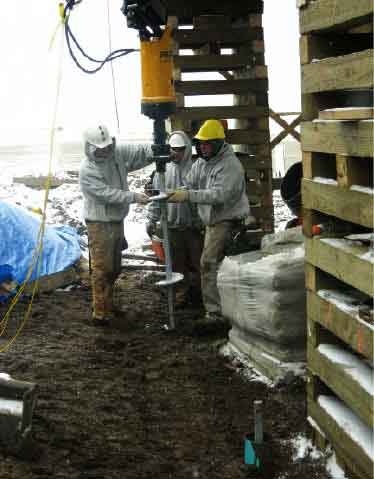
The auger attached to the arm of our track excavator is
basically a giant hydraulic screwdriver, capable of producing
12.5 kips (12,500 pounds-force). We first turn the lead section
into the ground to its full 5-foot depth, then attach a
proprietary displacement plate to the shaft (Figure 2). When
rotated, the displacement plate thrusts the soil aside to
create a grouting cavity around the shaft.


Figure 2. Helical piers don’t remove
material the way an auger does; instead they screw into the
soil with minimal disturbance. A displacement plate, shown here
upside down (top left) and added to the top of the lead section
(top right), creates a void around the shaft as it is screwed
into the ground. A 6-inch-diameter PVC casing fits onto the
displacement plate and is pressed into the soil along with the
first plain shaft section (bottom left). Incremental marks on
the casing allow the insertion torque to be tracked at 1-foot
intervals. Grout is poured in as each additional section is
coupled and driven (bottom right).
Friction-fitted to the digging plate is a 4-foot length of
6-inch-diameter PVC casing. The casing is pressed down along
with the next shaft length until it’s just about flush
with the grade, and becomes a reservoir for introducing grout
as shaft sections are added. We use a 2-to-1 sand mix with Type
II cement and just enough water to make the grout flow. The
grout is pulled downward by gravity and the square
shaft’s rotation, following the digging plate to
eventually encase the entire length of the pier above the lead
section.
Monitoring torque. There are a few
accepted ways to determine when you have reached the
pier’s designed capacity. The method we use is the most
precise, relying on a computerized torque indicator that
delivers a constant readout of the hydraulic pressure delivered
to the auger as it turns the shaft. We mark each shaft section
at 1-foot intervals and record the readout as each mark reaches
grade level (Figure 3).
Figure 3. A torque indicator with a direct feed from
the auger head measures the hydraulic force required to turn
the pier. A worker logs each pier’s insertion, noting the
torque reading per foot of insertion. Readings generally
increase with depth; sudden drops indicate voids in the strata,
such as a peat layer. Torque is measured in foot-pounds and
converts to bearing capacity at a ratio of 1-to-10. Thus, a
reading of 4,200 foot-pounds indicates the pier has a
42,000-pound capacity. Pier installation is complete when
design depth and capacity are reached.
While the engineer’s design documents required us to
submit for approval a complete record for each pier, an
engineer was also on site during the first few installations to
verify the field conditions and results.
Grade Beam
The reinforced-concrete grade beam — which looks just
like a footing — is essentially a structural header
spanning from one pier to another, providing full support to
the building. We shoveled a shallow trench for the
30-inch-by-16-inch beam, then placed the prescribed rebar
(Figure 4). There’s no need to dig in below the frost
line since the beam rides on the piers, not on grade.
Figure 4. Bearing plates (above) are welded to the top
of each shaft, just above grade. Vertical rebar dowels, welded
to the bearing plates, provide continuity from the pier through
the grade beam and stem-wall foundation.
On top of each pier’s bearing plate, we welded four #4
upright “dowels” with 10-inch horizontal legs to
tie in the stem wall. This ensured full continuity from the
bottom of the pier to the top of the foundation. We set similar
dowels on 16-inch centers along the entire length of the beam
for tying in horizontal rebar.
With the rebar tied and the beam formed, we pumped a 4,000-psi,
3/4-inch aggregate mix in from the street — about 90 feet
away — using the excavator arm to direct the pump hose
(Figure 5). We keyed the top of the beam to receive the
3-foot-4-inch-high stem wall, which we formed the following
day. We set pressure-treated wood bucks inside the forms for
the stainless steel Smart Vents (877/441-8368,
www.smartvent.com),
which will allow floodwater movement but exclude
critters.
Figure 5. The excavator operator guides concrete
placement for the stem wall (top), which is tied to the grade
beam with a hefty schedule of vertical rebar (above). Note the
knockouts for the required storm vents (right).
It took us two-and-a-half days to install a total of 21 piers,
at an approximate cost of $1,500 per pier. It took another week
to tie the rebar, and form and pour the beam and walls. With
the first-floor framing replaced and the entire structure
unified with wind-resistant metal connectors, this house should
stand for a long time to come.
Fred Ambrose is president of Ambrose Homes
in Chatham, Mass.