How a deck board performs over time is as important as how it looks when first installed. After a few seasons in the weather, fasteners can mushroom, board ends can split, colors can fade, and gaps between boards can become uneven. That’s why experienced deck builders put a premium on qualities like long-term dimensional stability. Those builders aren’t just choosing a finish surface—they’re looking to minimize future risk.
Risk reduction helps explain why newer material technologies have become popular. A great example is composite decking made with Deckorators’ Surestone technology, which uses mineral fillers rather than wood fibers. It’s lighter, stiffer, more dimensionally stable, and looks better over time than older composite or PVC deck boards.
Rich Villandry, owner of Villandry Home & Outdoor Living in Merrimack, New Hampshire, says that these qualities led his company to switch to Deckorators decking made from Surestone technology six or seven years ago. Today, it’s the only decking he presents to customers. Rich says, “The product stays consistent over time, so we continue to use it.”
Long-term consistency carries real weight in a climate like New Hampshire’s. In summer, temperatures can reach 95°F; in winter, ice and snow are everyday realities, and the thermometer can plummet to -20°F. “A lot of materials get stressed out with those swings,” Villandry says. “We need high performance, but a lot of other composites don’t offer that and don’t hold up well here.”
In fact, temperature-induced movement was one of the biggest complaints he heard about older composites. Over time, expansion and contraction can create visible problems around fasteners, at miters, and along picture-frame details. “You can get mushrooming at screw locations,” Villandry says. “And if the screw is near the end of a board, there’s a chance the board will crack there when it moves.”
Villandry says those problems have disappeared since he switched to decking made with Surestone technology. “We’ve had no callbacks,” he says.
That level of predictability is crucial on high-end outdoor living projects, where clients expect clean visual lines to remain stable year after year. “A 1/8-inch gap, whether between boards or between a picture frame and the field decking, has to stay that way no matter what,” says Villandry. He says that the dimensional stability of boards made with Surestone technology guarantees that.
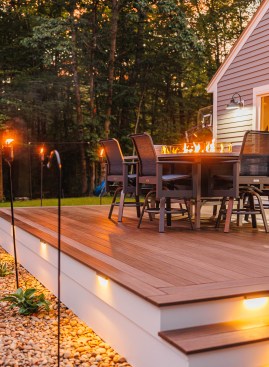
His customers also love how the product feels underfoot. A common homeowner complaint with some other composites is their “spongy” feel, but that’s not an issue with Surestone. “It’s a lot stiffer and feels more solid,” he says.
Slip resistance is another feature that matters when the deck gets wet, and Villandry says that decking made with Surestone performs especially well. “It has great slip resistance, so we can use it around a pool deck, for instance, without any worry about kids running around.” In addition to having great traction when wet, other water-adjacent benefits include mold and mildew resistance, and the fact that the boards are designed to resist heat buildup, making them comfortable to walk on with bare feet.
When it comes to installation, deck boards made with Surestone technology are lighter than many conventional composites, while at the same time rigid enough to easily handle during installation, according to Villandry.
For him to seriously consider something new, however, the manufacturer’s support must be as good as the product itself. Warranty coverage is obviously important, but so is responsiveness from suppliers and product sales representatives. “If a board gets scratched during delivery and we need a new one, we don’t want to wait for it,” Villandry says. “Deckorators has been great about support.”
Like many contractors, he relies heavily on industry relationships and peer feedback when evaluating new products. “Social media is big,” he says. “If I see another company using something, I’ll ask questions and ask around my network.”
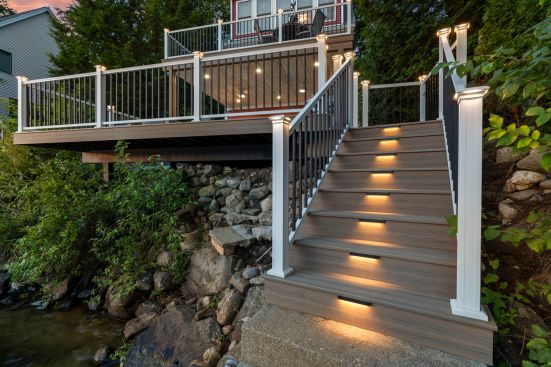
In the end, contractors like Villandry are looking for products that eliminate long-term uncertainty. A board that stays stable through seasonal swings, maintains consistent reveals, and avoids common movement-related failures can reduce callbacks, protect margins, and help preserve client relationships.
For Villandry, that reliability is what matters most, and he gets that reliability with decking made with Surestone technology. “It stays where we put it,” he says. “We can go back year after year, and it’s still looking great.”
For more information, please visit deckorators.com.