The sides or blade of a Speed Slot Hole Saw are made from bimeta…
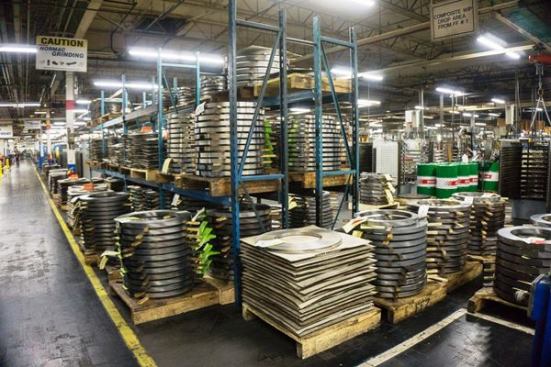
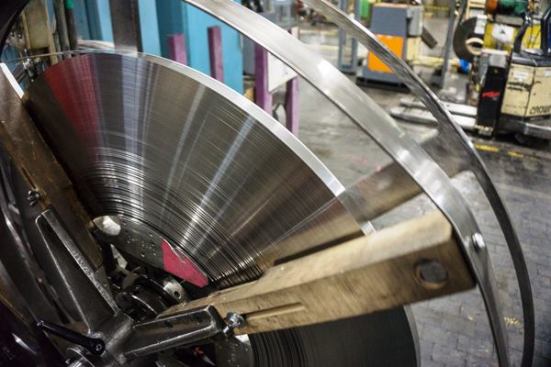
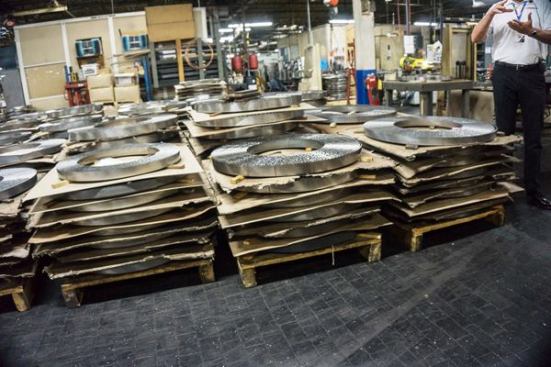
The sides or blade of a Speed Slot Hole Saw are made from bimetal material, a narrow strip of HSS (high-speed steel) edge-wire welded to a wider high carbon steel backer. The teeth are cut into the HSS, which is hard and resists wear better than high carbon steel. These are rolls of the carbon steel backing material before it’s attached to the HSS. It’s mind blowing to see how many towers of steel coil are stacked around the factory.
Brian Way
Lenox makes its own bimetal material. This high carbon steel bac…
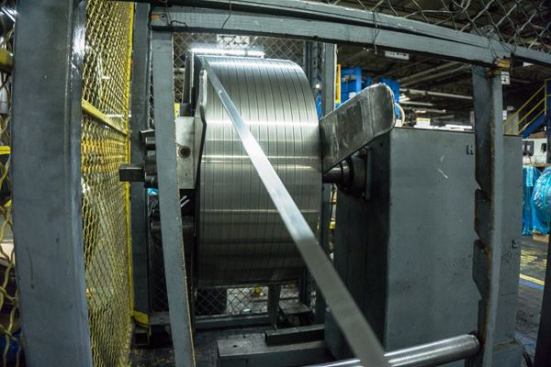
Lenox makes its own bimetal material. This high carbon steel backer will be fed into an electron beam welder and joined to the HSS edge-wire.
Brian Way
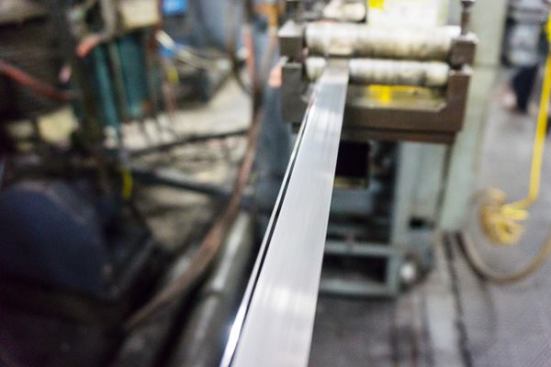
The edge-wire passes through straightening rollers before being …
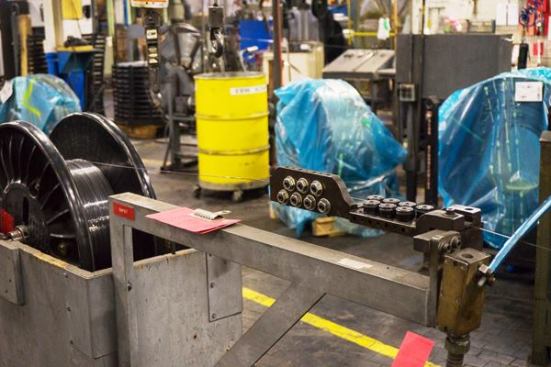
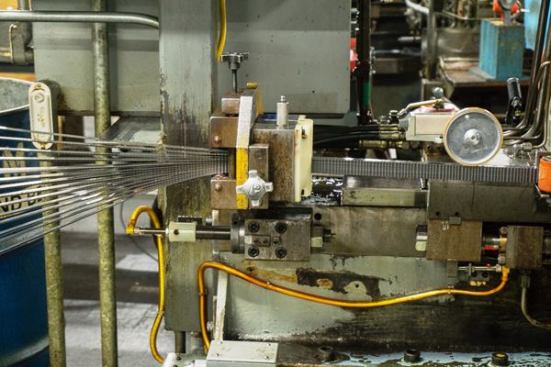
The edge-wire passes through straightening rollers before being fed into an electron beam welding machine.
Brian Way
…
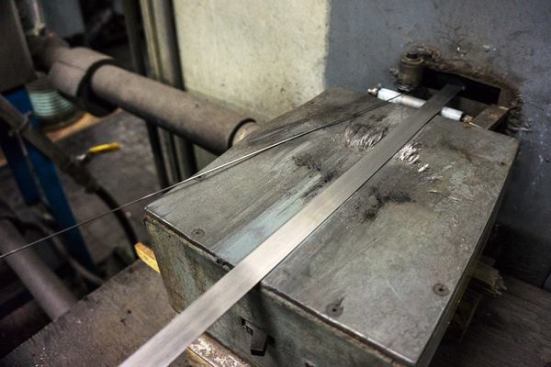
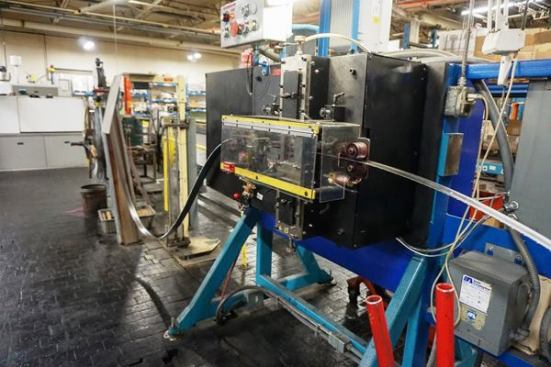
As they enter the welder the edge-wire and backer pass over a “box” containing an electromagnet. The magnet captures stray metal filings that could cause problems if they got inside the welder. Note the old-school toggle switch on the electromagnet (which looks like something I could build in my garage).
Brian Way
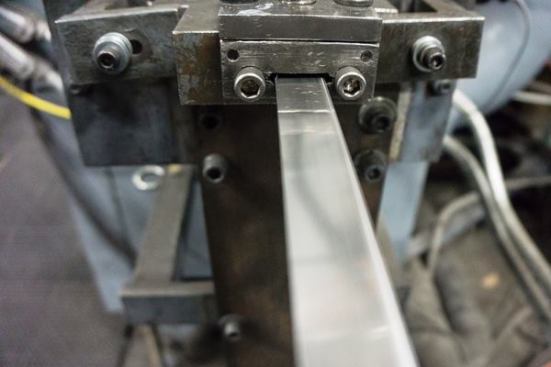
Here you can see the edge-wire and backer lined up before they e…
Here you can see the edge-wire and backer lined up before they enter the electron beam welding machine.
Brian Way
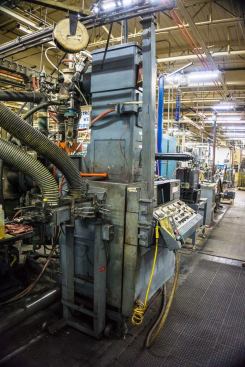
One of many electron beam welders in the facility, this particul…
One of many electron beam welders in the facility, this particular machine was designed in the 1960’s and has been in use ever since. Unlike regular welders, this machine uses an electron beam in excess of 7,000 degrees to fuse the two types of metal. Lenox has some newer equipment for this process, but I was not allowed to photograph it because they don’t want competitors to see it.
Brian Way
Here is the band after it has been welded. Bimetal material may …
Here is the band after it has been welded. Bimetal material may not look like much but that HSS edge makes all the difference when it comes to making hole saws (and recip blades) that will stay sharp for a very long time.
Brian Way
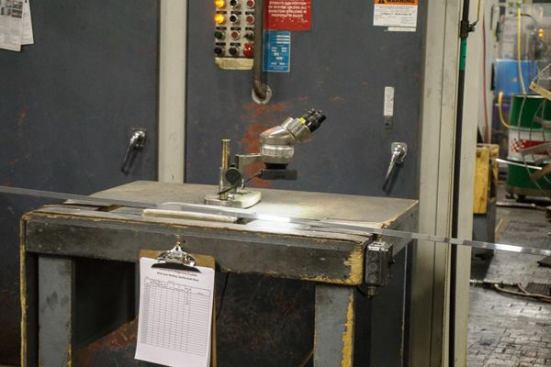
This old school microscope is used to spot check the quality of …
This old school microscope is used to spot check the quality of the weld.
Brian Way
The steel gets coiled again as it comes off of the welder. It is…
The steel gets coiled again as it comes off of the welder. It is then transported to the next operation, the tooth cutting machine.
Brian Way
Cutter heads such as these are used to cut teeth in the band mat…
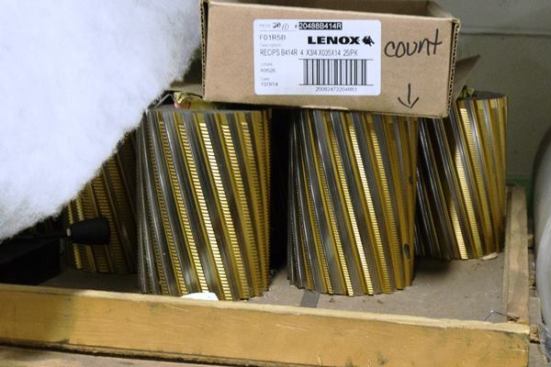
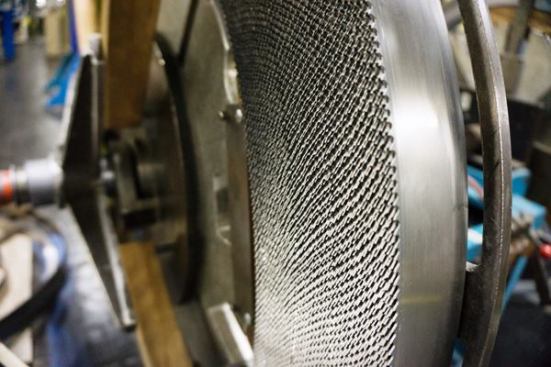
Cutter heads such as these are used to cut teeth in the band material for hole saw, recip saw, and band saw blades. You see these things all over the factory, as they are frequently changed out.
Brian Way
Multiple strips of bimetal material enter the machine on the lef…
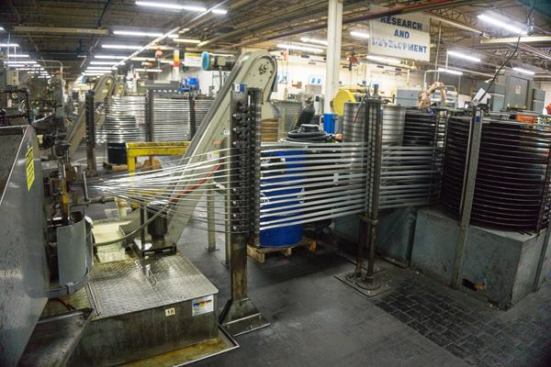
Multiple strips of bimetal material enter the machine on the left, where they will be stacked tight before having teeth cut into them by the type of cutter head shown in the previous slide. They essentially gang-cut the things. Talk about fast!
Brian Way
After the teeth are cut into them the bimetal strips exit the ma…
After the teeth are cut into them the bimetal strips exit the machine and rolled into individual coils.
Brian Way
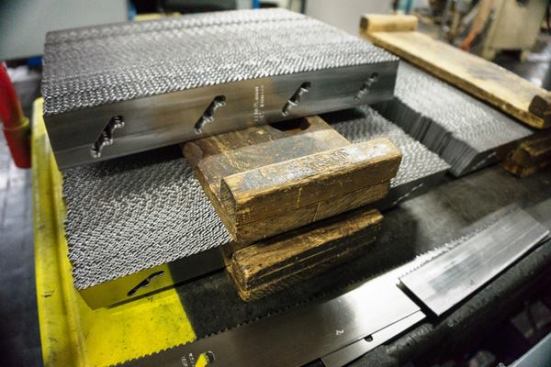
These coils of bimetal material have had teeth cut into them but…
These coils of bimetal material have had teeth cut into them but the teeth haven’t been set.
Brian Way
This coil of bi-metal material, has been placed on a reel and is…
This coil of bi-metal material, has been placed on a reel and is about to be fed into the machine that sets the teeth.
Brian Way
This is one of the machines Lenox uses to set teeth; it can set …
This is one of the machines Lenox uses to set teeth; it can set about 4 inches of teeth at a time. The strip goes in flat and comes out with the teeth set to the correct kerf width.
Brian Way
As soon as the teeth are set the stock enters a machine that pun…
As soon as the teeth are set the stock enters a machine that punches the blanks that will be turned into hole saws—the longer the blank the larger the diameter. I was not allowed to photograph the punching process. As you can see, the blades come out of the machine with the cutouts and stamped lettering already done.
Brian Way
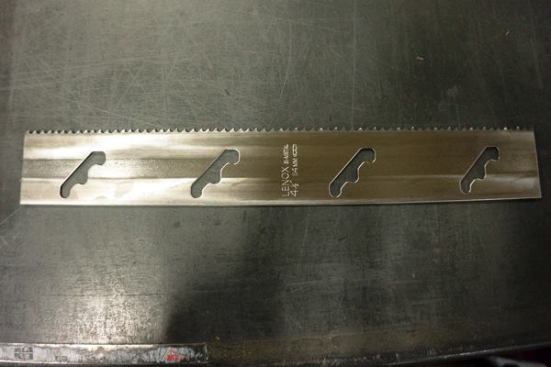
This stamped steel blade is ready to be formed into a hole saw.
Brian Way
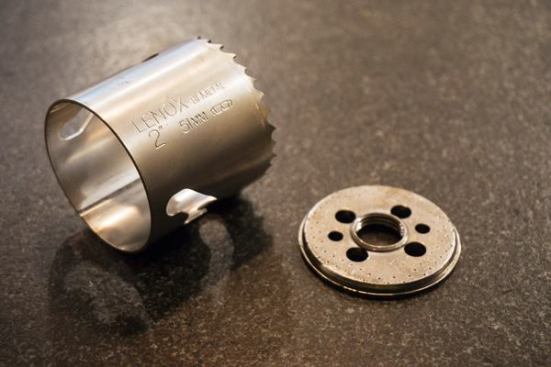
Here’s what the pieces look like after the sides have been for…
Here’s what the pieces look like after the sides have been formed but before the forged end piece is welded on. I was not allowed to photograph the operation in which the blank is formed into a curve—which is too bad because it was my favorite part of the process. I agreed not to describe it in detail, but can say it involves more than heating and bending.
Brian Way
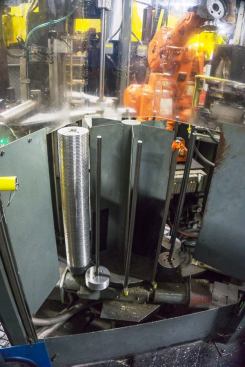
This “rotisserie” holds a stack of the forged steel plates (…
This “rotisserie” holds a stack of the forged steel plates (the flat end that connects to the arbor) that will be welded onto blades. They are stacked in this manner so a robotic arm can pick them up, position them, and hand them to the robot that does the welding.
Brian Way
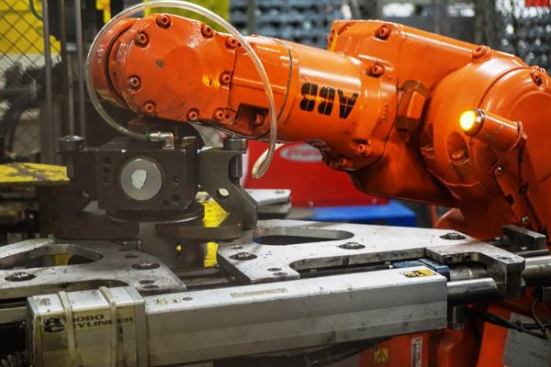
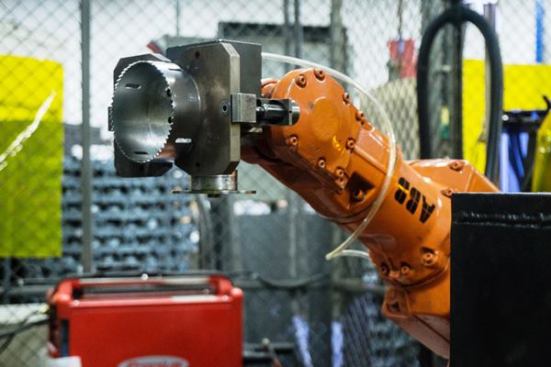
The robot grabs a plate & inserts it into the coiled blade. …
The robot grabs a plate & inserts it into the coiled blade. Another robot grabs the infant hole saw and brings it to the welding robot.The robot grabs a plate & inserts it into the coiled blade. Another robot grabs the infant hole saw and brings it to the welding robot.
Brian Way
The hole saw, with the forged rear plate has been picked up and …
The hole saw, with the forged rear plate has been picked up and is ready to be welded.
Brian Way
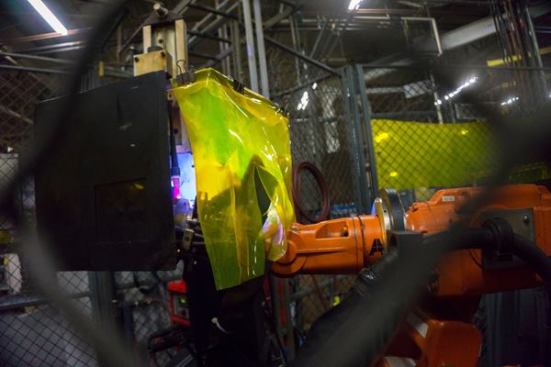
I would have loved to stick my camera in there and catch the wel…
I would have loved to stick my camera in there and catch the welding process—but peeking was not allowed. I am sure you can imagine what is taking place behind the curtain.
Brian Way
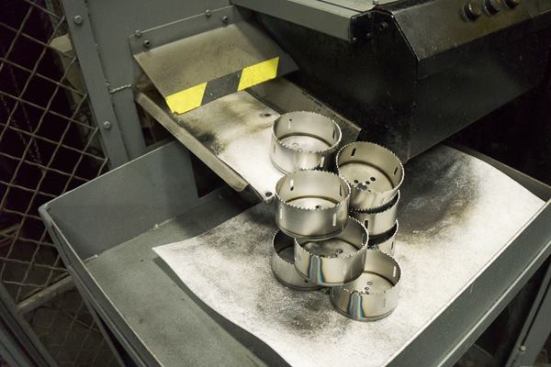
After the pieces are welded together, they are dropped into a tr…
After the pieces are welded together, they are dropped into a trough to cool.
Brian Way
The next step is heat treating—which takes place in large vat-…
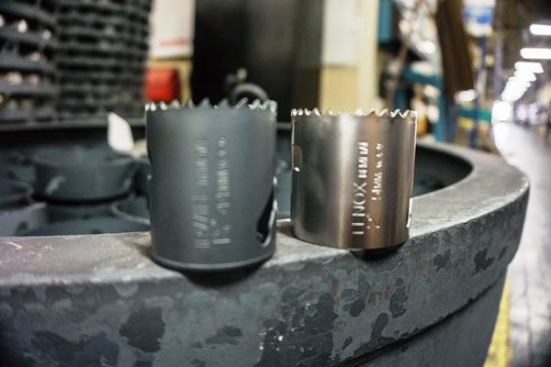
The next step is heat treating—which takes place in large vat-like furnaces where temperatures exceed 2,000 degrees. It takes many many hours to heat treat the pieces. The hole saws go in bright (like the piece on the right) and come out a dull grey color (like the one on the left).
Brian Way
After heat treating the hole saws are sent to a machine that pai…
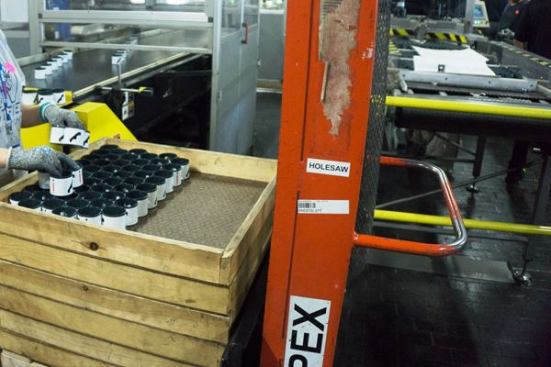
After heat treating the hole saws are sent to a machine that paints them an applies (prints) the company logo. One of the unique things about Lenox is that they only paint the outside of the hole saw. The inside is raw steel—which reduces friction and the likelihood of gumming during use.
Brian Way
These finished hole saws have been stacked and are awaiting ship…
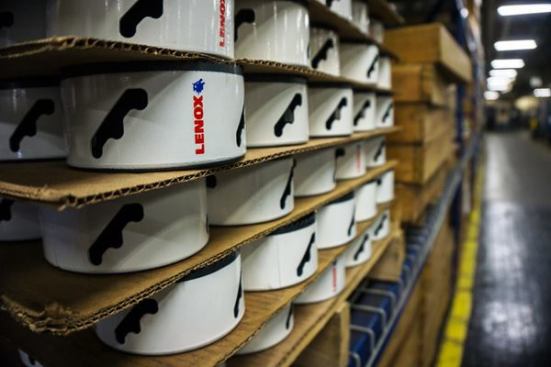
These finished hole saws have been stacked and are awaiting shipping. The shelves that contain them seem to go on for miles.
Brian Way
In this area of the plant hole saws and recip blades are tested …
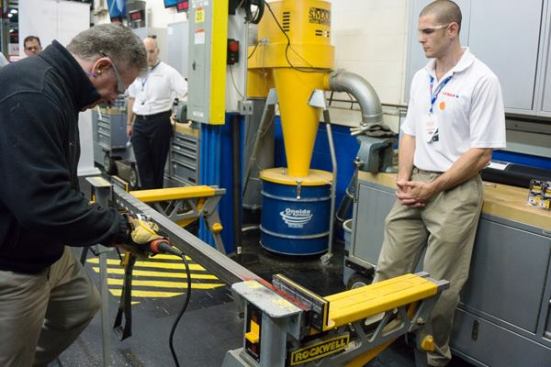
In this area of the plant hole saws and recip blades are tested on a variety of materials—and against competitors’ products. The fellow in the dark jacket was on the tour with me and is using a hole saw to drill a piece of stainless steel.
Brian Way
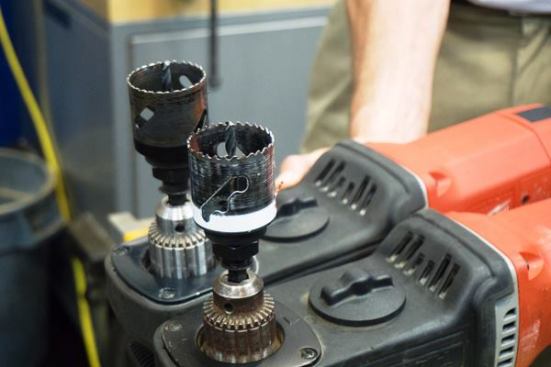
The nearest saw is from Lenox and was able to drill twice as man…
The nearest saw is from Lenox and was able to drill twice as many hole Uni-Strut as a competitors saw, and it still has teeth left!
Brian Way
Lee “Hackman” Breton came back for the 100 year anniversary …
Lee “Hackman” Breton came back for the 100 year anniversary event. He surprised me by cutting through a door so fast I was unable to catch a photo. He’s more or less retired now but you can see him in his prime in the video on the main page of this story. Hackman has cut more things in half than probably any man alive: railroad cars, planes, tanker trucks, armored cars, and something like 500 autos.
Brian Way
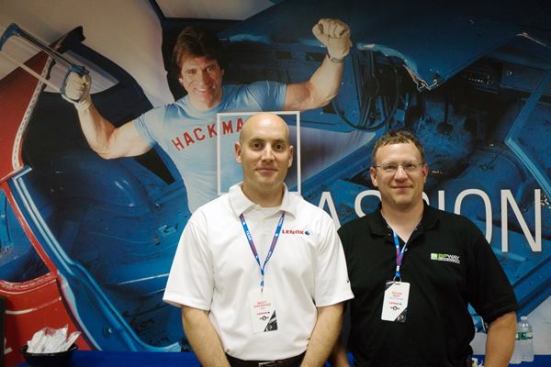
That’s Matt Savarino (Brand Manager) on the left and me on the…
That’s Matt Savarino (Brand Manager) on the left and me on the right. Matt gave me a second (private) tour of the plant, which is how I was able to get most of these photos. Thanks Matt!
Last month I attended Lenox’s 100th anniversary event at the company’s headquarters and factory in East Longmeadow, MA. There was a presentation on the company’s history, demonstrations of new products, and best of all—a tour of the factory.
The only thing that came close to the tour was getting to meet Lee Breton, the developer of bimetal hacksaw blades who came to be known as Hackman. During his years as Hackman Breton cut in half everything from freight trains, airplanes, and tank trucks, to houses and more than 500 cars in order to demonstrate the cutting ability of Lenox blades (video below)
Tools of the Trade has already published a story about the manufacture of recip saw blades; this story is about the manufacture of hole saws. It’s a fascinating process and you can see it by clicking the slideshow on the left side of this page.
As for the company, it was founded in 1915 as the American Saw and Manufacturing Company and later became Lenox. It began with the production of hacksaw blades, moved on to band saw blades (the number one item sold by the company), and became a major player in the construction industry by producing hole saws and recip saw blades. Lenox was acquired by Newell Rubbermaid in 2003.
Be sure to see the slideshow of my tour of the factory. But before you do, here are some fun facts I picked up at the event:
Lenox produces approximately 600,000 feet of bi-metal strip every day
It makes 34,000 miles of blades every year—enough to circle the globe 1 1/2 times.
The factory covers 13.77 acres and employs 900 people.
The electrical bill for the factory is $600,000 per month.
The Speed Slot Hole Saw (what I saw being made) was introduced in 2011
Within the factory one guy can run 30 CNC machines per shift.
The video below shows Lee “Hackman” Breton in his prime, cutting a box car in half in 1987. For more classic cuts see Hackman Historical Cuts.
Brian Way is a frequent contributor to Tools of the Trade. He’s a cabinet-maker, furniture builder and millwork installer and runs BPWay in Northford, CT. Brian is also an inventor of the TailLock and owns Kaizen Foam Inserts – customized foam for tool boxes.