Thickened-edge slabs make practical foundations where soils are stable. But building codes mandate special foundation designs in areas with expansive soils, because seasonal swelling and shrinking of the soil can cause significant cracking of both the foundation and the structure it supports. A proven solution for these conditions is a post-tensioned slab, which uses a grid of high-tensile steel cables — rather than conventional wire mesh or rebar — to provide strength and control cracking.
The reinforcing cables and their specialized end fittings are cast into the center of the slab before the pour. After the concrete has cured for a few days, each cable, known as a tendon, is stretched with a hydraulic ram, placing slab and footings under compression. The tendons are sheathed with a tough plastic that prevents them from bonding to the concrete; a coating of lubricant between the sheath and the cable inside allows the cable to stretch freely during the tensioning process. This pre-compression lets the foundation behave like a prestressed concrete beam in resisting the tensile loads imposed by soil uplift or subsidence.
Post-tensioned slabs have been used since the 1960s but have become more common over the past two decades. As a structural engineer with a California firm that designs hundreds of post-tensioned residential slabs each year, I’ve found that they’re simple to build, economical, and reliable.
Soil Conditions
California and Texas are well known for their expansive clay soils, but similar soil conditions are found across a wide swath of the central Great Plains and in pockets of varying size nationwide.
Expansive soils are an especially serious problem in areas with wide seasonal variations in soil moisture content. During hot, dry summer weather, clay soils shrink, while extended periods of wetter weather cause the soil to expand. Since the slab itself tends to protect the soil directly beneath from wetting and drying, most swelling and shrinking take place at the edges. Determining the expansiveness of a given soil is a job for a qualified geotechnical engineer.
Measuring soil expansiveness. In designing a foundation, two variables covered in the soils report are especially relevant to the structural engineer. The first is the Ym value, or Differential Swell, which refers to the extreme range of soil movement that could occur. (Like other worst-case engineering values, this number expresses a possibility and doesn’t mean that that much movement will occur.) Differential Swell is expressed in inches. A value of 4 or less indicates that the soil can support a properly designed post-tensioned slab.
If the Ym figure is higher than 4, a geotechnical engineer will need to develop a different — and generally more costly — foundation plan. One common approach would be to bore down to bedrock or competent soil and cast piers that support a grade-beam foundation (see “Trouble-Free Foundations for Expansive Soils,” 11/02).
Moisture penetration. The second key value is what’s known as the Edge Moisture Variation Distance, or em. This refers to the distance inward from the edge of the slab that the soil moisture content can be expected to vary. As you would expect, this number is largely a function of local climate: The wetter the conditions, the farther moisture can be expected to penetrate; the drier the conditions, the wider the area of drying. The higher the em value, the greater the stresses acting on the slab. A good source for more information is Design and Construction of Post-Tensioned Slabs-on-Ground (Post-Tensioning Institute, Phoenix, Ariz.; 602/870-7540, www.post-tensioning.org).
Uniform-Thickness vs. Ribbed Slabs
There are two basic types of post-tensioned residential slabs. Uniform-thickness slabs are typically about 9 inches thick throughout, except at the perimeter footings and where isolated footings are needed to accept heavy point loads or provide extra embedment depth for metal structural connectors.
Ribbed slabs, by contrast, usually measure about 5 inches thick but contain an internal grid of thicker footings that give them a waffle-shaped cross section. These ribs can be placed up to 17 feet apart in each direction and are required to extend from one slab edge to the other. They’re typically located under walls or posts, so their placement is tied to architectural drawings. In addition to providing strength and stiffness against expansive soil movement, the ribs can be used to anchor metal connectors and shear walls.
Slab loading. Although heavy structural loads are usually carried by footings, post-tensioned slabs are strong enough to carry moderate loads directly. When planning for point loads, a safe rule of thumb is to figure on 1,000 pounds per inch of slab thickness. A 5-inch post-tensioned slab can handle up to 5,000 pounds, and a typical 9-inch-thick slab will bear a concentrated 9,000-pound load. In addition, both the International Building Code and the Uniform Building Code provide design methods for determining the capacity of a post-tensioned slab to support the load from a bearing wall. Especially with a uniform-thickness slab, this may make it possible to do away with interior footings entirely.
Labor and materials. Uniform-thickness slabs have the advantage of simplicity. Most of the trenching is limited to the exterior footings, which helps keep labor costs down. On the other hand, uniform-thickness slabs require more concrete. Plus, because the minimum number of tendons for the slab is determined by its cross-sectional area, the uniform-thickness slab will also require more tendons than a thinner ribbed slab of the same square footage.
In practice, either approach can be used to satisfy the strength and stiffness criteria of the code. We find that most builders simply go with the version they’re most familiar with.
Excavation and Forms
Except for the reinforcing, post-tensioned slabs are excavated and formed exactly like conventional residential slabs. Once the site has been cleared of vegetation and other organic material, the slab is laid out and staked, along with the positions of any internal ribs. The clay soils we work with are generally solid and hard, so vertical-walled trenches readily hold their shape. In looser soils, trenches must sometimes be sloped to prevent loose material from falling into the bottom.
There’s a minimal danger of uplift from frost in our part of California, so the perimeter footing only needs to be deep enough to satisfy the soils report and to resist the vertical, lateral, and expansive soil load of the structure. Our company uses a minimum 18-inch embedment into the soil at the exterior footings. The trenches that form the ribs are also about 18 inches deep.
Once the foundation crew has staked the perimeter forms in place and braced them with diagonal kickers, they cover the prepared subgrade with a poly vapor barrier. With a uniform-thickness slab, it’s easy to do this with a few continuously overlapping sheets. A ribbed slab, with its internal trenches, is a little trickier. The usual construction practice is to cover each soil “block” with its own sheet of poly and leave the trenched areas uncovered.
The poly is typically covered with a layer of sand or gravel, as specified by the geotechnical engineer, to protect the vapor barrier from damage when the concrete is placed and to help with the curing of the concrete.
Tendon Layout
The exact spacing of the tendons will vary depending on the thickness of the slab and other variables. An on-center spacing of 3 to 4 feet or so is typical of most residential foundations. With relatively few tendons to keep track of, the layout is easy to inspect, and problems are easily identified and corrected.
But the nominal tendon spacing is more an average than a hard and fast rule. As long as the foundation contains the required number of tendons, the exact spacing between them can be somewhat flexible. For example, within a nominal 4-foot grid, the actual distance between any two tendons could vary between 3 and 5 feet or so. The endmost tendons in a given run must be located within 2 feet of the edge of the slab, but no closer to it than 6 inches.
Dead-end attachment. For most moderate-sized residential slabs, the precut tendons are delivered from the supplier with a cast-iron anchor plate permanently attached to one end.
The end with the attached plate, or dead end, is fastened to the form board with two 20d nails. The tendon is then unrolled across the subslab to the tension-end (or stressing-end) anchor on the opposite slab edge. Tendons need not run in a completely straight line; they can be diverted a foot or so to one side to avoid plumbing stacks or other obstructions, as long as they follow a gradual curve. For the 1/2-inch tendons used in most residential slabs, the rule is not to bend the tendon to a curve tighter than a 10-foot radius.
Pocket formers. Unlike the anchor at the dead end, which is supported on the form board by its nails, the tension-end anchor is mated to a hollow plastic pocket former that fits into a hole in the form board.
The tension end of the tendon is inserted through a hole in the cast-iron anchor and pocket former and out through the corresponding hole in the form, leaving 2 feet or so of tendon sticking out beyond the slab edge. Once the slab has been poured and the forms have been stripped, the pocket formers are removed, leaving a cavity designed to accommodate the hydraulic ram that will later be used to stress the tendons.
For slabs longer or wider than 70 feet or so, the friction created between the slab and the subgrade significantly reduces the force in the tendon from one anchor to another. For these spans and greater, anchors with pocket formers are used at both ends so the forces can be equalized.
Additional reinforcing and connectors. As the tendons are placed, they are wired together where they intersect and supported by wire or plastic chairs.
Some areas, such as inside corners or pop-outs, require the addition of conventional rebar to minimize cracking or reinforce the section. Once the supplementary rebar and all required anchor bolts and structural hold-downs have been wired in place, the site is ready for concrete.
Pouring and Tensioning the Slab
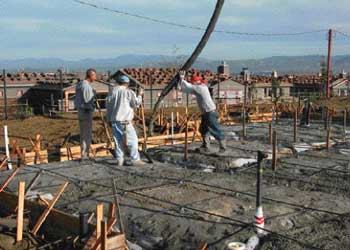
A post-tensioned slab is poured and finished like any other residential slab, using conventional 2,500-psi or higher concrete with a 4- or 5-inch slump. The concrete crew pours the perimeter footing and any interior ribs before filling the forms the rest of the way.
The entire design philosophy of post-tensioned foundations demands that the interior and exterior footings work with the slab to resist any applied loads. For that to happen, it’s essential to avoid horizontal cold joints between the footings and the slab. Most residential slabs can easily be poured monolithically, but for larger slabs it’s sometimes necessary to use vertical construction joints to create more manageable pour sizes.
Handle with care. The slab may look ready to go once the forms have been stripped, but because the tendons — unlike conventional rebar — are unbonded to the concrete, it’s effectively unreinforced until the tendons have been stressed. Builders often want to begin framing as soon as the forms are stripped, a day or two after the pour, and that doesn’t ordinarily pose any problems. Foot traffic and the weight of the framed walls typically aren’t heavy enough to damage the slab. As with any green concrete, though, it’s best to avoid driving vehicles onto the slab or subjecting it to heavy point loads.
Because there’s little conventional rebar to help minimize shrinkage cracking, it’s imperative to stress the tendons as soon as the concrete has cured enough to permit it. Our drawings allow the contractor to stress the tendons once the concrete has reached a minimum compressive strength of 2,000 psi. In addition, we require that the slab be stressed within five days of the pour and that an ACI-approved curing method be used.
Pulling the tendons. The tendons are stressed with a portable hydraulic ram powered by an electric motor. This is a fairly straightforward process: The exposed strand is inserted into a slotted groove on the bottom of the ram. Once the tendon is secure, the jack is moved along the tendon until the tapered nosepiece presses against the cast-iron anchor embedded in the stressing pocket. A camming device grips the cable and stretches it when the ram is activated.
This stretching process involves enormous force and should be done only by a qualified operator. A typical tendon in a residential foundation is placed under 33,000 pounds of tension — enough to stretch the 1/2-inch steel cable by 4 inches or so over a 50-foot run. A gauge on the ram lets the operator know when the proper tension has been reached. At that point, the main hydraulic cylinder holds the tension steady while a pair of secondary cylinders forces two small, tapered steel wedges into a space between the tendon and the embedded anchor.
Double-ended pulls on longer tendons are accomplished by temporarily wedging the tendon to the anchor at one end, subjecting the other end to the full tensioning force and wedging that end permanently. The ram is then brought around to the temporarily wedged end of the tendon and stressed to the maximum gauge pressure. Once the gauge pressure has been reached, that end is permanently wedged, as well.
With the tensioning force locked in place by the wedges, the ram can be removed and moved ahead to the next cable. All this happens very quickly. A two-person crew — one to operate the ram and another to watch the gauge pressure — can tension a dozen or more foundations in a day. As required by code, a building inspector is also present to confirm that each cable is tensioned as specified and to record the elongations of the tendons.
Grouting the pockets. Once the tendons have been pulled and have passed inspection, the protruding cable ends are cut off inside the stressing pockets, an inch from the edge of the slab. There are specialized hydraulic shears designed for this purpose, but the usual tool of choice on residential jobs is an acetylene torch. The protruding ends of the nails used to fasten the anchors to the forms are torched off at the same time. Finally, the stressing pockets are filled with grout to protect the anchors, cables, and wedges from the weather. Bryan Allred is a structural engineer with Seneca Structural Engineering in Laguna Hills, Calif.