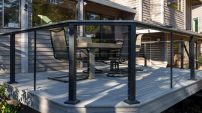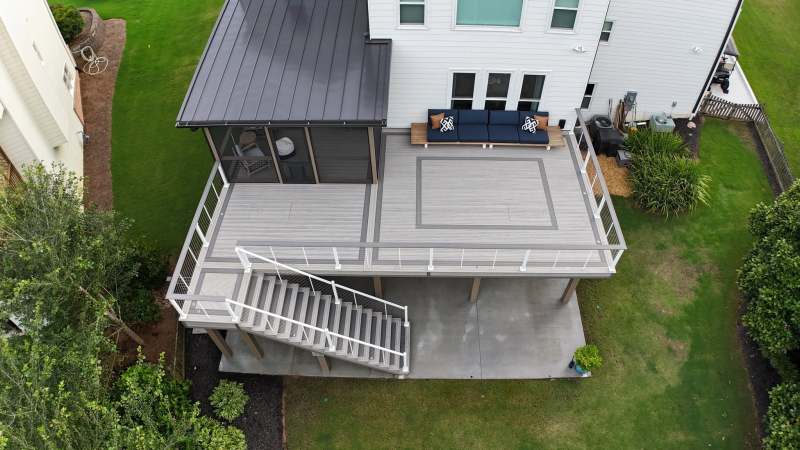
Homeowners often call an outdoor contractor, thinking they know exactly what they need, such as a 16×20 deck with a covered porch and a place for a grill. It’s tempting to give them what they ask for, but Derek Kirchner says that’s a mistake.
Kirchner, owner of Atlanta-area Kirchner Customs, sees his initial role as a consultant. Rather than jumping to dimensions and materials, he asks about the family and their lifestyle. Do they have children? Pets? Do they like to entertain? What are their hobbies? How might their needs change in five or 10 years?
“Armed with this information, I can say, ‘You could benefit from this feature, this functionality,’” he says. He looks to uncover needs homeowners may not have recognized.
Look for Opportunities
On one project, Kirchner discovered that the family loved playing cornhole. He thought about using leftover decking to make them a set of cornhole boards, but then one of his employees found photos of boards recessed into a deck surface that could be tilted up for a game.
The homeowners loved the idea.
It required more than cutting a couple of holes in the decking. Kirchner contacted the builder who had done the project and obtained 3D plans. His crew fabricated a custom aluminum frame beneath the deck, notched the framing, and cut the decking so the boards would sit flush when not lifted. They even installed lighting underneath so the playing area could be illuminated at night.
On another project, the clients were an older couple who intended to remain in their home, and the wife was passionate about birds. So Kirchner worked with the husband to surprise her with custom birdhouses.
He researched the species she liked and learned that different birds require different opening sizes, floor areas, and entrance heights above the floor. He spaced the houses far enough apart to reduce territorial conflicts, built them from composite material matching the deck, and hinged the roofs so they could be cleaned. They cost very little to make but were one of the most valuable details to the homeowner.
Suggest Alternatives
Creative problem-solving can mean telling homeowners that what they’re asking for won’t work particularly well.
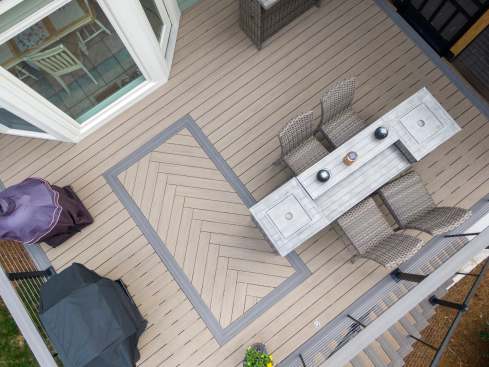
One client wanted to define the dining area on her deck with an outdoor rug. Kirchner pointed out that it would hold moisture, causing problems over time. He suggested creating a similar look with the deck itself: a herringbone inlay surrounded by a picture-frame border.
The feature required some additional labor but didn’t add much cost. Good solutions can be relatively affordable.
Think About Tomorrow
It’s also important to think about how the homeowners will use the deck in the long term. His typical project runs $60,000–$80,000, so he asks homeowners to consider what they’ll need from the space 10, 20, or 30 years down the road.
A family with small children may need considerably more entertaining space when they become teenagers. A homeowner who can’t afford a roof today might want one in a couple of years. If that’s a possibility, Kirchner can size the footings, posts, and beams to support that future addition.
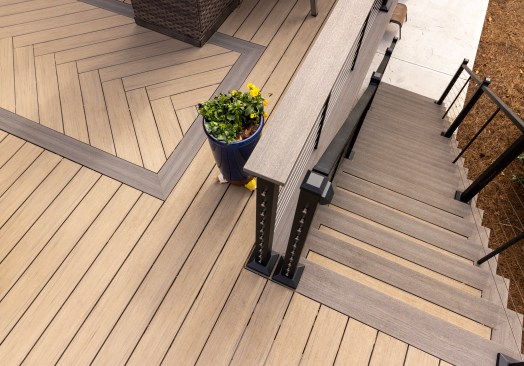
Material choices are always part of the conversation. For families with children, Kirchner pays particular attention to slip resistance, especially on stairs and wet decks. That’s one reason Deckorators decking has become his go-to product. “They by far have the most slip-resistant materials out there. The surface can be soaking wet, and kids could have covered it with soap bubbles, and I’m not going to slide across it.”
Longevity matters below deck as well. Kirchner frames with marine-grade pressure-treated lumber, covers the tops of joists and beams with flashing tape, adds extra flashing where the deck meets the house, and uses structural screws rather than nails. “I don’t want to put a 25-year product on top of a 10-year frame,” he says.
Sell the Why
Coming up with good solutions isn’t enough. You also must sell the homeowner on why those solutions make sense.
For instance, when Kirchner upgraded his project specs from wood decking to the more durable and maintenance-free Deckorators composite products, he developed a cost-benefit analysis comparing the upfront costs with the ongoing expense of staining the deck boards every three to five years. “The numbers show that the costs break even after the first stain,” he says. Those long-term cost savings have been a strong selling point.
That same principle applies to design. Contractors who understand how customers live can propose features and layouts that solve problems the homeowners hadn’t considered. And contractors who can explain the reasoning behind those recommendations have a better chance of getting customers to embrace them.
Another benefit, according to Kirchner, is that customers seeking this level of custom work recognize its value, which has helped him move toward more distinctive—and more profitable—projects.
The goal should be to become better at listening, identifying problems, and proposing solutions. Don’t just ask homeowners what they want you to build. Find out how they want to live—and help them figure out what you should build for them.
For more information, please visit kirchnercustoms.com.