Q. I’ve never been comfortable sweating copper supply lines (I’m a remodeler, not a plumber). Given the steep cost, does it make sense to invest in a press tool? Are any other remodelers running these tools, and if so, what should I know about them?
A. Jeremy Kassel, owner/operator of Kassel Construction in Glenmont, N.Y., a remodeler of 22 years, and a frequent presenter at JLC Live responds: The cost upfront was a concern for me also when I bought mine back in 2018. I had rented the tool a couple of times and decided that the utility of it made it worth purchasing. Renting a tool has a cost not just in the rental charge but also in the time needed to get and then return it. I waited for an upcoming sale at my local supply store and pulled the trigger. The $1,800 still stung though.
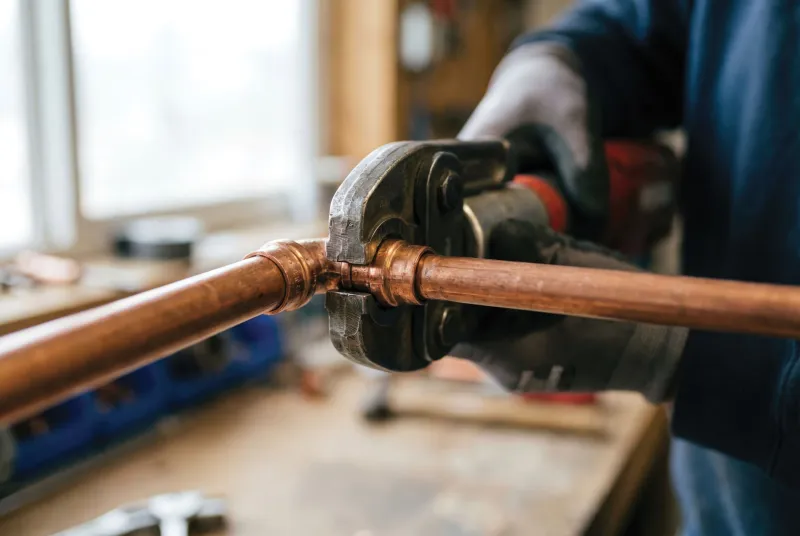
A quick description for those who aren’t familiar with the tool: A press tool hydraulically compresses a ring within specialized fittings onto the pipe. The jaws of the tool are first lined up over the part of the fitting that contains the rubber compression ring. When the tool is activated, the jaws close completely around the ring and squeeze it until the tool reaches its maximum pressure. The tool then releases, resulting in a secure leak-proof joint that requires less time and skill than threading or soldering. Fittings match common pipe connections, such as shutoffs, elbows, and conversion joints.
There are manual versions of the tool but the one I got was the Milwaukee cordless Force Logic. It works both with brand-name fittings (like ProPress) and the generic press fittings that you see at the box stores. There are also different-sized press jaws that can be switched out on the tool to let you work on various pipe diameters. The tool is most often used to get a fitting onto copper pipes but can be used on other materials, such as black iron, stainless steel, and PEX.
I haven’t regretted the outlay of money: The tool has helped me speed up work and allows me to do things that would have been difficult without it. I am not a plumber, but in my area contractors can do plumbing work if they schedule a plumbing inspection with the city. Of course, you should check what the regulations are in your jurisdiction. Having used these press fittings for a few years now I have not had any failures or issues come up with the work I’ve done.
The advantages for me have been, first off, no fire. Not having to solder with an open flame in old homes, often in tight spaces, is huge. I am okay at soldering, but it is not something I do every day, whereas pressing a leak-proof fitting on a pipe does not take much practice.
The speed with which the fittings can be installed helps me work efficiently, but the biggest plus is I can get an end cap or shutoff valve installed even if the pipe still has water in it. Often, closing the old main water shutoff would still allow a trickle of water through. Or, I wouldn’t be able to get the system to drain well enough and there would still be water, preventing me from soldering a fitting on. Not having to worry about completely drained pipes saved me many times and let the work proceed quickly.
In the homes I work on, we are usually connecting to original copper and then switching to a plastic tubing like PEX (for cost reasons). The flexibility of being able to choose materials is great. I have also ended up using the tool for boiler pipes: They are often the hardest to get all the water out of, but now I can isolate the area temporarily with a shutoff valve and move on with the work and reconnect later.
I think of my purchase of this tool in the same way I view the purchase of a metal brake (or any capital investment for that matter). You can buck up and spend the $1,800 to $2,800, or you can keep renting or going to a metal fabrication shop to get parts made. But once you have the tool, you can be more flexible with the work you take on. You just have to decide if this is a tool that you need, regardless of the cost. In my case, I’ve recouped the big upfront cost by expanding the type of work I’m able to do.
Keep the conversation going—sign up to our newsletter for exclusive content and updates. Sign up for free